Doreen (Marlo Thomas) and Carla (Lisa Emery) try to figure out what to do with George in Elaine May’s GEORGE IS DEAD
Brooks Atkinson Theatre
256 West 47th St. between Broadway & Eighth Ave.
Opens Thursday, October 20, $65-$135 (October 14 performance reviewed)
www.relativelyspeakingbroadway.com
“I don’t have the depth to feel this bad,” Doreen (Marlo Thomas) says in the second of three one-act comedies that make up Relatively Speaking, which opened October 20 at the Brooks Atkinson Theatre. While the trio of short plays that deal with family — by writers much better known for their film work — might lack depth individually and as a group, two of the three don’t have much to feel bad about it. The evening opens with Oscar winner Ethan Coen’s (Fargo, No Country for Old Men) extremely slight Talking Cure, which is divided into two sections that feel like they were vignettes that Coen couldn’t think of how to use elsewhere so he threw them together here and hoped for the best. In the first part, Danny Hoch plays a patient in a mental institution trying to convince a psychiatrist (Jason Kravits) that there is nothing wrong with him. The second part reveals why he just might be crazy, flashing back to his parents (Katherine Borowitz and Allen Lewis Rickman) having an argument about Hitler. (Rickman replaced A Serious Man’s Fred Melamed, who left over creative differences with Coen. One can see why.)
After a four-minute pause, Elaine May’s (A New Leaf, Heaven Can Wait) George Is Dead begins, set in a small, cramped New York City apartment where Doreen barges in on Carla (Lisa Emery) in the middle of the night. Doreen announces that her husband has just died — and that she has left him in a Colorado hotel room because she doesn’t know what to do. A wealthy socialite wearing a glittering dress, Doreen has unexpectedly turned to the daughter of her old nanny (Patricia O’Connell), who is not exactly thrilled to suddenly have to take care of her former nemesis. Thomas gives a breathless tour-de-force performance as the ditzy, discombobulated Doreen; at one point she says to Carla, who is in the midst of an awful fight with her husband (Grant Shaud), “You’re so dear. Am I being too horribly demanding? Am I being awful? I can never tell.” The play’s final scene seems tacked on and unnecessary, but the rest of it is a small pleasure.
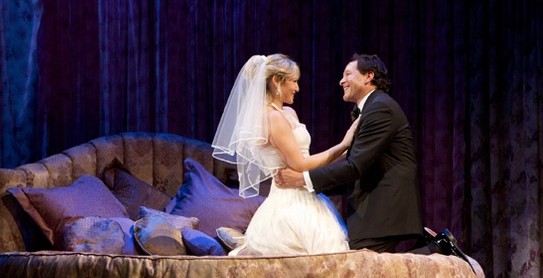
Nina (Ari Graynor) and Jerry (Steve Guttenberg) set in motion a farcical family drama in Woody Allen’s HONEYMOON MOTEL
Following a fifteen-minute intermission, Woody Allen’s (Annie Hall, Crimes and Misdemeanors) Honeymoon Motel takes over, a drawing-room farce that pays tribute to the Marx Brothers’ classic stateroom scene from A Night at the Opera. Jerry Spector (a solid Steve Guttenberg) and the much younger Nina (Ari Graynor) arrive at a wonderfully cheesy Vegas-like motel room (courtesy of set designer Santo Loquasto), apparently to consummate their marriage, but it turns out that Jerry is actually the stepfather of the groom (Bill Army) and has fallen in love with the sexy blonde. As the room slowly fills up with the whole mishpucha — Mark-Linn Baker and Julie Kavner as Nina’s dysfunctional parents; Caroline Aaron as Judy, the groom’s overbearing mother; Kravits as Jerry’s shrink; Hoch as the pizza delivery guy; and Richard Libertini as a tipsy rabbi — Allen lets the Borscht Belt one-liners flow, with more hits than misses. “What did I do? You two were planning on divorce anyway,” Nina says. “We were? It’s news to me,” responds Judy. “I never said divorce,” adds Jerry. “I was thinking of faking my own death.” After Judy calls Jerry’s best friend, Ed (Shaud), an enabler, Ed says, “Enabler? I was trying to talk him out of it when you came.” Judy: “You’re the first one that told him about sex in a Jacuzzi.” Ed: “I’ve never been in a Jacuzzi in my life.” Judy: “Well, he made me try it and we ended up dialing 911.” Jerry: “She accused me of waterboarding her.” Not exactly high-brow humor, but a lot of fun, even if Libertini’s rabbi falls flatter than a Kol Nidre pledge speech. Directed by John Turturro, who has appeared in films by Coen and Allen, Relatively Speaking is like a family reunion, complete with its fair share of ups and downs, touching moments and long-simmering arguments, at least one or two people you’d rather not see, and enough laughs to make you glad you went.
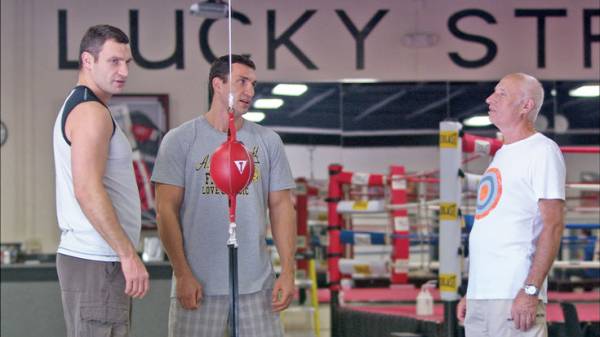
 When brothers Vitali and Wladimir Klitschko first entered the boxing arena in the 1990s, they were each like Ivan Drago in Rocky IV, seemingly unbeatable Russian machines. But both of them ended up facing tremendous adversity and rising up again, as depicted in the surprisingly intimate German documentary Klitschko. Director Sebastian Dehnhardt was given unlimited access to the brothers, their parents, Vitali’s wife, and other members of Team Klitschko, revealing the two skyscrapers to be much more than just a couple of great fighters. Both Vitali and his younger brother, Wladimir, are shown to be intelligent, well-spoken men (each with PhDs) who had one goal when they left kickboxing for professional boxing — to be heavyweight champions of the world. On their remarkable journey, Dehnhardt captures them training together, carefully watching each other’s performances in the ring, and playing chess. At one point Wladimir bans Vitali from his training camp, evoking the separation between “Irish” Micky Ward and his brother, Dicky Eklund, as seen in David O. Russell’s Oscar-nominated The Fighter, but the Klitschkos handle it very differently. The film features plenty of original fight footage in which Dehnhardt zooms in and slows things down to get breathtaking action shots from such contests as Vitali’s epic battle with Lennox Lewis, in which Klitschko got a horrifically deep gash over his left eye; Wladimir’s dizzying loss to Lamon Brewster; and both brothers taking on Corrie Sanders and Samuel Peter. Sharing their thoughts on the Klitschkos are longtime manager Bernd Bonte, Wladimir’s trainer Emanuel Steward, Vilati’s coach Fritz Sdunek, former champions Lewis, Brewster, and Chris Byrd, and boxing announcer Larry Merchant, none of whom have anything bad to say about the brothers, who come off as calm, thoughtful souls who love their mother dearly and rarely get riled up outside the ring. The film is disjointed, with an often hard-to-follow time line, and background information seems haphazard at best, but Klitschko is still a knockout of a film.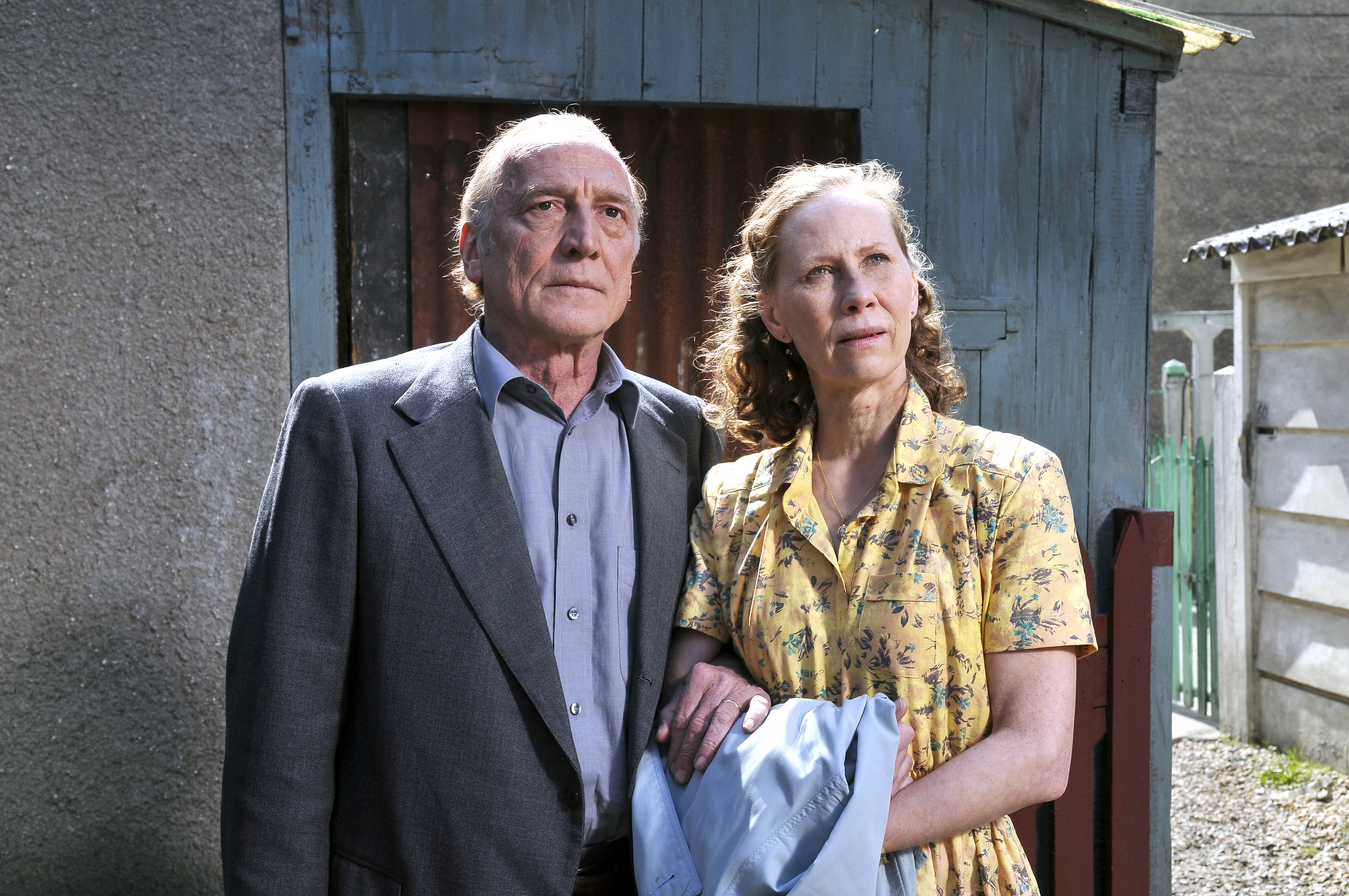
 For nearly thirty years, Finnish auteur Aki Kaurismäki (Leningrad Cowboys Go America, The Man Without a Past) has been making existential deadpan black comedies that are often as funny as they are dark and depressing. Has there ever been a film as bleak as 1990’s The Match Factory Girl, in which a young woman (Kati Outinen) suffers malady after malady, tragedy after tragedy, embarrassment after embarrassment, her expression never changing? In his latest film, the thoroughly engaging Le Havre, Kaurismäki moves the setting to a small port town in France, where shoeshine man Marcel Marx (André Wilms), a self-described former Bohemian, worries about his seriously ill wife (Outinen) while trying to help a young African boy (Blondin Miguel), who was smuggled into the country illegally on board a container ship, steer clear of the police, especially intrepid detective Monet (Jean-Pierre Darroussin), who never says no to a snifter of Calvados. Adding elements of French gangster and WWII Resistance films with Godardian undercurrents — he even casts Jean-Pierre Léaud in a small but pivotal role — Kaurismäki wryly examines how individuals as well as governments deal with illegal immigrants, something that has taken on more importance than ever amid the growing international economic crisis and fears of terrorism. Through it all, Marcel remains steadfast and stalwart, quietly and humbly going about his business, deadpan every step of the way. Wouter Zoon’s set design runs the gamut from stark grays to bursts of color, while longtime Kaurismäki cinematographer Timo Salminen shoots scene after scene with a beautiful simplicity. Winner of a Fipresci critics award at Cannes this year and Finland’s official entry for the Best Foreign Language Film Oscar, Le Havre is another marvelously unusual, charmingly offbeat tale from a master of the form. A selection of this year’s New York Film Festival, Le Havre opens October 21 at Lincoln Plaza and the IFC Center, which is also hosting a Kaurismäki festival on weekends through December 18, showing nine of the director’s works; up next is The Match Factory Girl (October 28-30), followed by Leningrad Cowboys Go America (November 11-13), Leningrad Cowboys Meet Moses (November 18-20), and The Man Without a Past (November 24-27).

 Screening at 92YTribeca as part of the third annual Doomsday Film Festival — which promises “Deserted streets! Blood-red skies! Total social breakdown!” — Stanley Kubrick’s Dr. Strangelove is one of the grandest satires ever made, the blackest of black comedies. With the threat of nuclear annihilation looming over the United States and the Soviet Union, General Jack D. Ripper (Sterling Hayden) has a meltdown, becoming obsessed with protecting the country’s “precious bodily fluids” and threatening to launch the bombs. While President Merkin Muffley (Peter Sellers) tries to make nice with the Soviets, General Buck Turgidson (George C. Scott) gets caught up in all the military excitement, Colonel Bat Guano (Keenan Wynn) defends the Coca-Cola company, Group Captain Lionel Mandrake (Sellers) can’t get anyone to listen to him, and Major T. J. “King” Kong (Slim Pickens) prepares for the ride of his life. Based on Peter George’s novel Red Alert and written by George, Kubrick, and Terry Southern, Dr. Strangelove or: How I Learned to Stop Worrying and Love the Bomb is hysterically funny and wickedly prescient, an absolute hoot from start to finish, featuring razor-sharp dialogue, inspired slapstick, and just enough truth to scare the hell out of you. (Be sure to watch for Peter Bull not being able to stop laughing as Sellers goes crazy in a wheelchair at the end.) The screening will be followed by a “Doomsday on the Brain” panel discussion with Joseph Le Doux, Dr. Mark Siegel, Lee Quinby, Keith Uhlich, and Mark Asch, moderated by Paul W. Morris from, of course, BOMB magazine. The Doomsday Film Festival also includes Steve De Jarnatt’s 1988 WWIII flick Miracle Mile, followed by a Q&A with star Anthony Edwards and the director; Don McKellar’s 1999 Y2K nightmare Last Night; Joseph Sargent’s classic Colossus: The Forbin Project, followed by “The Singularity Is Nigh,” a panel discussion with Maggie Jackson, Joshua Rothkopf, Jason Zinoman, Chris Bregler, and Roger Schank, moderated by Michael Byrne; Tobe Hooper’s 1985 exploitation fave Lifeforce, preceded by complimentary sexy alien zombie makeup; a collection of short films; and schlockmeister Larry Cohen’s 1976 cop drama God Told Me To, followed by a Skype Q&A with Cohen. If the end of the world is coming, this is a fine way to say goodbye.