Yearly Archives: 2011

BLAME IT ON BECKETT

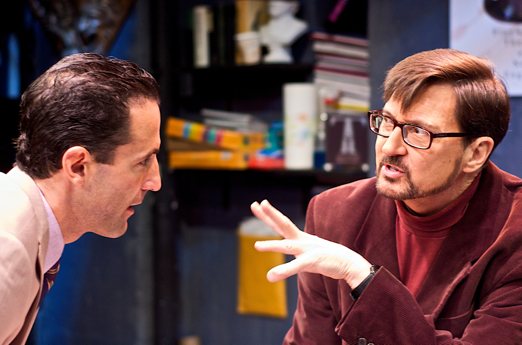
General manager Mike Braschi (Mark Doherty) and dramaturg Jim Foley (Warren Kelley) are at odds in BLAME IT ON BECKETT (photo by Anthony J. Merced)

Dorothy Strelsin Theatre
Abingdon Theatre Arts Complex
312 West 36th St. between Eighth & Ninth Aves.
Through October 30, $25
www.abingdontheatre.org

Just what is a dramaturg anyway? In John Morogiello’s Blame It on Beckett, Warren Kelley stars as Jim Foley, a jaded, cynical dramaturg for a regional New England theater who spends his days not answering his phone and rejecting works by new playwrights based on their titles or how they’re bound. He gets unwanted help in the form of box-office girl Heidi Bishop (Lori Gardner), a bright-eyed and innocent theater major who dreams of being a dramaturg, convincing slick, smarmy general manager Mike Braschi (Mark Doherty) to let her work for free as a part-time intern for Foley, who is sickened by her youthful enthusiasm and drive. Heidi and Jim are soon butting heads over a six-page monologue in a play by the company’s last best hope, Tina Fike (Anne Newhall), setting in motion sexual intrigue, scandal, betrayal, and other nasty business. While Morogiello and director Jackob G. Hofmann, who previously teamed up on the Abingdon Theatre Company’s widely praised Engaging Shaw, cover fairly familiar territory, essentially moving All About Eve from the stage to the back room, they do so with an energetic wit and engaging characters. They include plenty of inside jokes, the Abingdon itself being a nonprofit theater company hoping their productions make it to the big time. Andrew Lu’s set features a desk, a few chairs, coffee cups strewn about, large piles of unread scripts, a bust of Shakespeare blindfolded — to protect the Bard from seeing what has become of his beloved profession — and various other theatrical paraphernalia, with the audience seated almost claustrophobically on three sides. With solid performances all around, surprisingly lively action, and some very funny lines, Blame It on Beckett is an insightful little comedy about ambition that, oddly, does not list a dramaturg in its program.
ELECTRIC SIX: HELLO, DESTRUCTOR!!!!

Bowery Ballroom
6 Delancey St. between Bowery & Chrystie St.
Friday, October 28, $18-$20, 8:00
212-533-2111
www.boweryballroom.com
www.electricsix.com

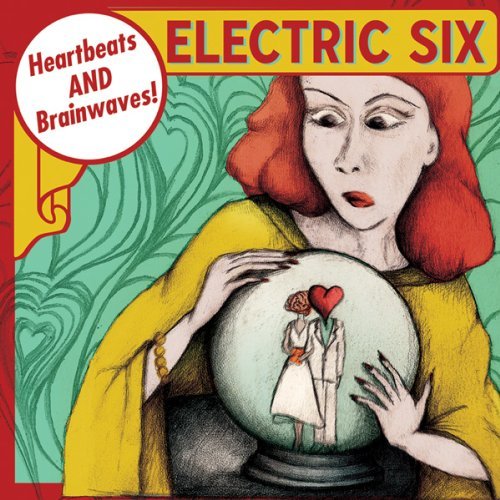
Leaning more on the synth-heavy dance rock that has long made them a party-band favorite— who doesn’t love “Gay Bar”? — genre-melting Detroit funk-pop rockers Electric Six are back with an explosive new disc, Heartbeats and Brainwaves! (Metropolis, October 11, 2011). Their eighth studio album oozes hot sex, rife with single and double entendres while channeling Nick Cave, Prince, Roxy Music, David Bowie, Ozzy Osbourne, and even Phil Collins. “Bodies bouncing on the floor / Everybody getting’ wild / Gonna show my dirty style / You better show me what that body’s for / You’re born to beguile / Hit the volume on your dial / Yeah, the dime is dropping on ya,” bandleader Dick Valentine sings on “It Gets Hot,” while on “Interchangeable Knife” he proclaims, “I’m gonna make you howl like a trailer-park wife / on the first day of her new life.” On “The Intergalactic Version” he might repeat “We write the same song over and over again,” but that is far from the case, with all six band members — vocalist Dick Valentine, drummer Percussion World, guitarists Johnny Na$hinal and the Colonel, bassist Smorgasbord, and synth master Tait Nucleus? — contributing to the songwriting process, which ranges from demonic goth rock and raucous heavy metal to ’80s MTV power pop and bootie-shaking funk. Electric Six brings its high-energy Hello, Destructor!!!! tour, named for a line in “Hello! I See You!” (“Hello, destructor! I’m yours for the destroying”), to Bowery Ballroom on Friday night, with Kitten and New York Rivals also on the bill. Perhaps Valentine says it best in this piece of promo copy about Heartbeats and Brainwaves!: “It manages to be so entertaining that you completely forget that your limits of time/space comprehension render you completely unable to answer why you are really here.”

OLAF BREUNING: THE ART FREAKS

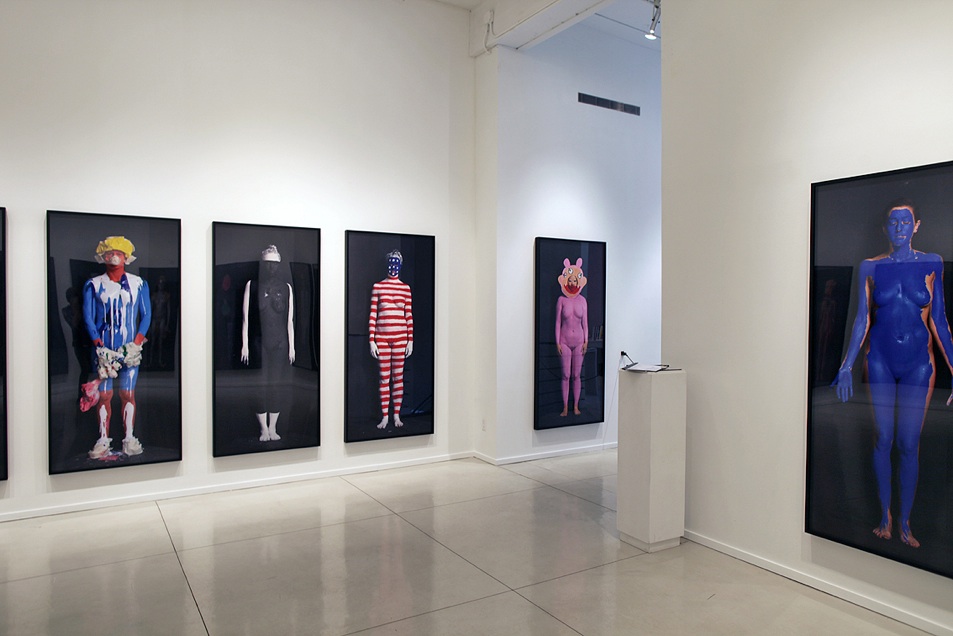
In “The Art Freaks,” Olaf Breuning combines painting, photography, and art history in entertaining ways (photo courtesy Olaf Breuning / Metro Pictures)

Metro Pictures
519 West 24th St. between Tenth & Eleventh Aves.
Through October 29, free, 10:00 am – 6:00 pm
212-206-7100
www.metropicturesgallery.com

For his latest show at Metro Pictures, New York-based Swiss artist Olaf Breuning has taken large-scale photographs (74 3/8 x 34 1/8 inches) of nearly two dozen models who have been painted in the style of some of the most famous and important artists of the twentieth century. In “The Art Freaks,” Breuning re-creates iconic works on the naked bodies of men and women, honoring such seminal figures as Edvard Munch, Yves Tanguy, Joseph Cornell, Frida Kahlo, Piet Mondrian, Jean-Michel Basquiat, Damien Hirst, Takashi Murakami, Andy Warhol, On Kawara, Jackson Pollock, and others. As always with Breuning’s work, his playful sense of humor shines through as he gives a unique art history lesson; we strongly suggest you first walk through the upstairs gallery space trying to identify the referenced artists yourself before confirming it by checking the photos’ titles.

RESIDUE: AN INSTALLATION BY EIKO & KOMA

Eiko & Koma take a look back at their life and career in “Residue” (photo by twi-ny/mdr)

The New York Public Library for the Performing Arts
Dorothy and Lewis B. Cullman Center, Vincent Astor Gallery
40 Lincoln Center Plaza, 111 Amsterdam Ave. between 64th & 65th Sts.
Through Saturday, October 29, free, 12 noon – 6:00 or 8:00
www.eikoandkoma.org/residue
www.nypl.org

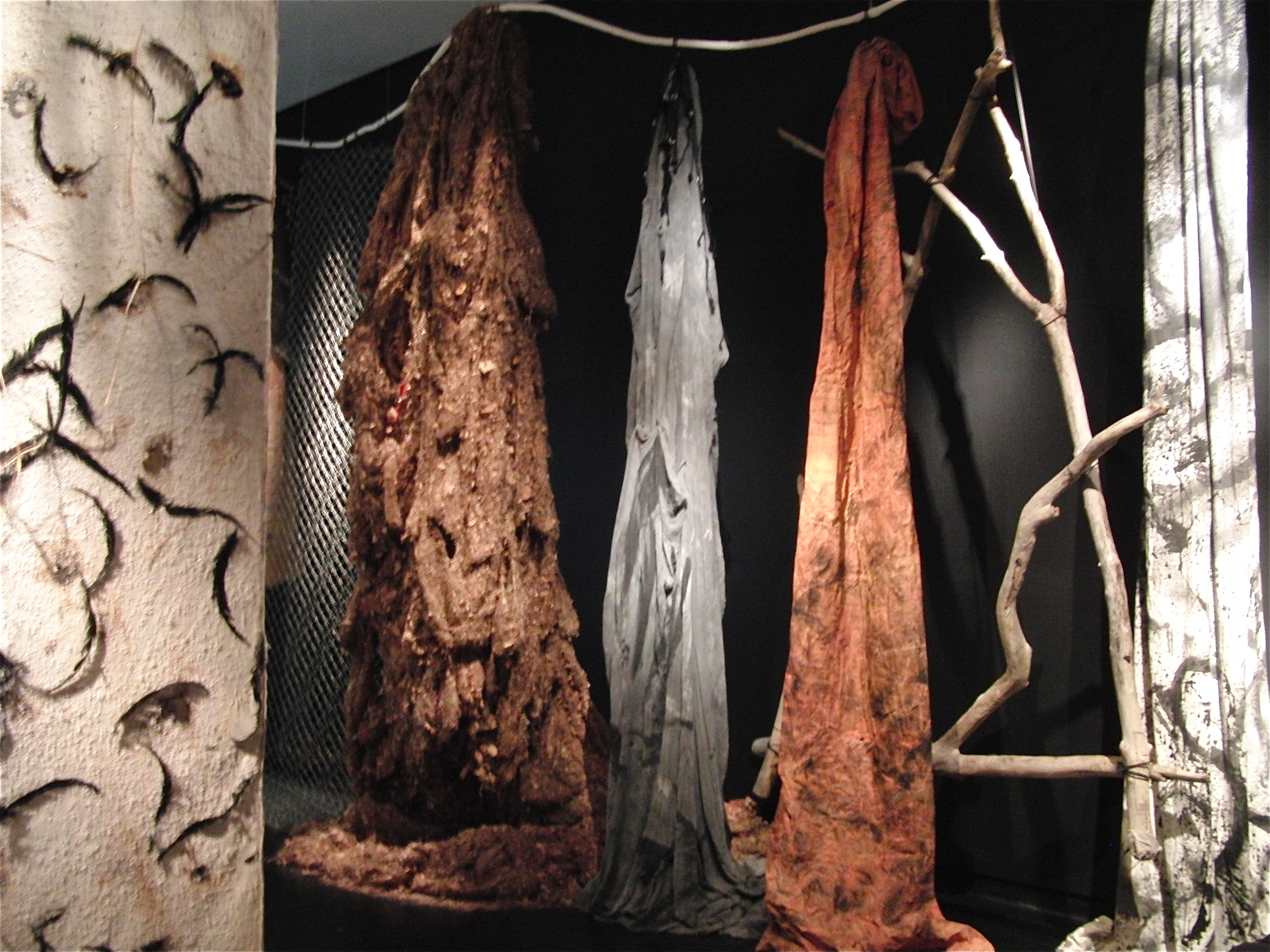
It’s been quite a year for Japanese dance couple Eiko & Koma here in their home base of New York City. Celebrating their fortieth anniversary together, Eiko Otake and Takashi Koma Otake performed the postapocalyptic dance installation Naked at the Baryshnikov Arts Center in the spring, went for a dip in the Paul Milstein Pool on Lincoln Center’s Hearst Plaza for the mesmerizing Water this summer, and held numerous local talks and workshops. And, as part of their three-year Retrospective Project, they’re taking a look back at their career in the unique gallery installation “Residue,” on view at the New York Public Library for the Performing Arts through October 29. Designer Eric Bissell has transformed the Vincent Astor Gallery into a dark, hypnotic space featuring paraphernalia from throughout Eiko & Koma’s career, including costumes, sets, a series of white rectangular wells screening videos at the bottom, and a central structure similar to the Naked wall where visitors can walk in, sit down, and watch Naked on a monitor on the floor. “Residue” highlights such works as Hunger, River, White Dance, Thirst, Grain, Wind, Tree, and Offering, organic pieces in which Eiko and Koma are often naked, performing in the outdoors or on stark sets. “It is very clear nothing lasts,” Koma says in the exhibition brochure. “So this installation too is not an attempt to last or save what we have done,” Eiko responds. “We just look at the ‘dust’ and enjoy that we can look at it for now.” Visitors will be able to look at and enjoy the dust of Eiko and Koma’s continuing adventurous career through the end of the week, and as an added treat the duo will be at the gallery on Saturday from 4:00 to 6:00 to meet and greet everyone who stops by.

NEW YORK FOUNDATION FOR THE ARTS PRESENTS: AN EVENING WITH JAMES CASEBERE

JAMES CASEBERE IN CONVERSATION WITH HAL FOSTER
Barnes & Noble
150 East 86th St. at Lexington Ave.
Wednesday, October 26, free, 7:00
212-369-2180
www.barnesandnoble.com
www.jamescasebere.net

Born in Michigan and living in Fort Greene since the late 1990s, James Casebere has spent the last thirty years making constructed photographs, creating table-sized architectural landscapes and turning them into haunting large-scale photographs of suburbia, the American West, prisons, and eighteenth-century America. His work has now been collected in James Casebere: Works 1975-2010 (Damiani, October 31, 2011, $80), a midcareer survey of his fascinating oeuvre. Edited by Okwui Enwezor, the book includes essays by Hal Foster and Toni Morrison as well as a talk between Enwezor and Casebere. “Rocking our sense of security and danger, James Casebere probes domestic and public spaces in order to expose the porous borders between them,” Morrison writes in the foreword. “He introduces foreign elements, manipulating light and our visual expectations of the sacred and profane; the safe haven versus confinement; privacy versus secrecy; wilderness versus shelter. He estranges the familiar and warps the conventional in hospitals, church-inflected architecture, ordinary home furnishings, corridors, and prisons.” In celebration of the book’s publication, the New York Foundation of the Arts is presenting the free event “James Casebere in Conversation with Hal Foster,” October 26 at the East 86th St. Barnes & Noble, in which the photographer sits down with the noted art critic, followed by a book signing.

TONEELGROEP AMSTERDAM: CRIES AND WHISPERS

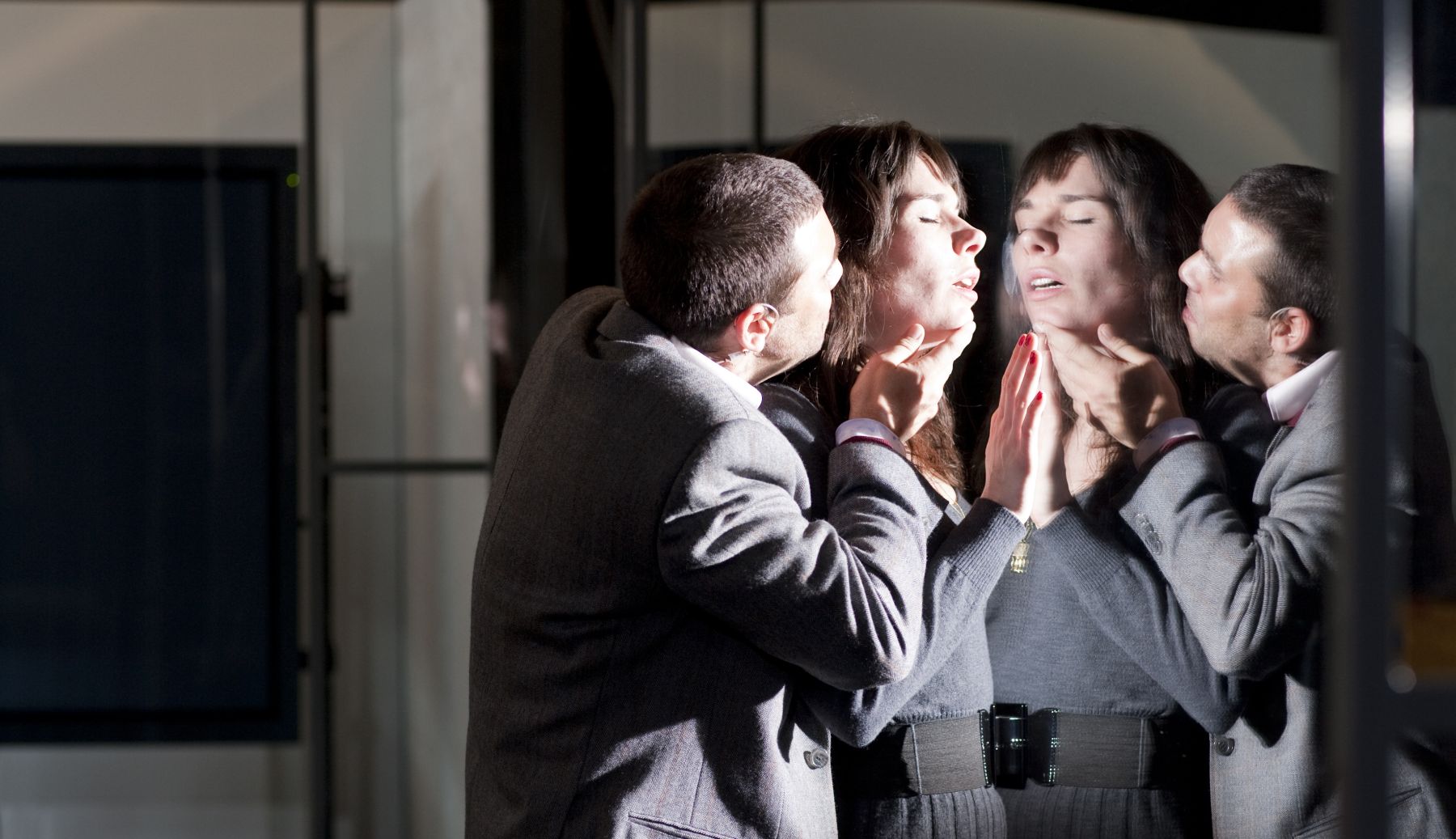
A brave artist’s impending death is the focus of multimedia stage adaptation of Ingmar Bergman’s CRIES AND WHISPERS at BAM (photo by Jan Versweyveld)

Brooklyn Academy of Music
BAM Harvey Theater
651 Fulton St. between Ashland & Rockwell Pl.
October 25-29, $25-$80, 7:30
718-636-4100
www.bam.org
www.tga.nl

The Brooklyn Academy of Music has had a long and fruitful relationship with Swedish director Ingmar Bergman, presenting his films as well as stage productions over the decades. Among the plays Bergman directed at BAM were A Doll’s House, Long Day’s Journey into Night, Miss Julie, The Ghost Sonata, Maria Stuart, and Ghosts, and shortly after his death BAM put together a stellar lineup of actors to read from his diary, including Bibi Andersson, Pernilla August, Lena Olin, and Peter Stormare. BAM and the late auteur continue their collaboration this week with the U.S. premiere of Toneelgroep Amsterdam multimedia adaptation of Bergman’s 1972 intense family drama Cries and Whispers, which starred Harriet Andersson, Kari Sylwan, Ingrid Thulin, and Liv Ullmann. The Dutch company, led by director Ivo van Hove, has previously adapted such cinematic gems as John Cassavetes’s Faces, Husbands, and Opening Night and Luchino Visconti’s Rocco and His Brothers and Ludwig in addition to classic works by Shakespeare, Molière, Williams, Hellman, O’Neill, Ibsen, Chekhov, Pinter, and others. Cries and Whispers features scenography by Jan Versweyveld, dramaturgy by Peter van Kraaij, video design by Tal Yarden, costumes by Wojciech Dziedzic, and sound design by Roeland Fernhout, all coming together for what looks to be an appropriately complex and moving experience.

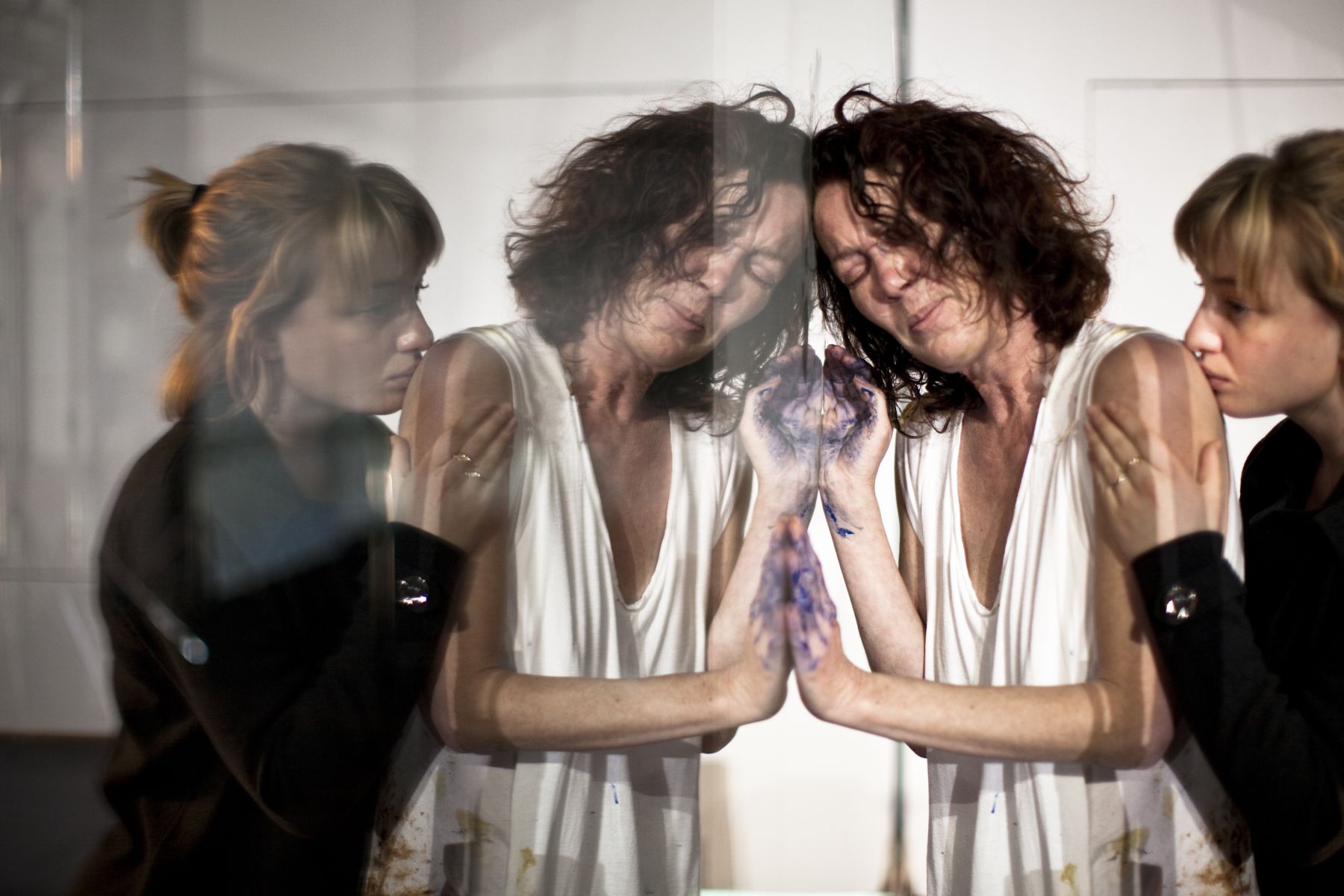
A family faces some harsh truths in CRIES AND WHISPERS (photo by Jan Versweyveld)

Update: Ivo van Hove paints a harrowing, brutal, yet ultimately strangely comforting portrayal of death in Toneelgroep Amsterdam’s intense and, at times, inexplicable Cries and Whispers, running at BAM’s Harvey Theater through October 29. Liberally adapted from Ingmar Bergman’s 1972 film — the company previously staged Bergman’s epic, documentary-like Scenes from a Marriage — this multimedia version turns the protagonist, Agnes (an immensely brave Chris Nietvelt), into a visual artist who is recording her final days, evoking Hannah Wilke’s “Intra-Venus” project. Jan Versweyveld’s stunning set contains mirrors, video screens, television monitors, a drop-down white surrounding wall, reflective glass, and multiple rooms in a mansion where Agnes is being cared for by her sisters, Karin (Janni Goslinga) and Maria (Helina Reijn), and her attending nurse, Anna (Karina Smulders). The pain Agnes feels is physically and emotionally palpable, echoing throughout the theater, especially when she releases an ear-piercing, shattering death howl as an overhead camera swings like a pendulum counting down her last breaths. The twelve silent minutes that follow are mesmerizing — and the show is still barely half over at that point. Although van Hove offers snippets of the other characters’ lives, not enough is learned about them, and there is a heavy dose of nudity, both male and female, that seems titillating but not always necessary. And some viewers might need a stronger stomach when Agnes takes care of some unpleasant bodily functions in plain view. Van Hove has added personal touches to the story, influenced by the death of his own father, who died in 2007, the same year as Bergman. The white color scheme is offset by Agnes’s blue paint and videos, providing a stark contrast that pays homage to Sven Nykvist, who won the Oscar for Best Cinematography for his camerawork on the film version. Van Hove recently told Gothamist that he’ll be back at BAM with an even bigger production for the 2012 Next Wave Festival; we can’t wait to see what he has up his sleeves for that.

STRANGER THAN FICTION: JAY ROSENBLATT SHORTS

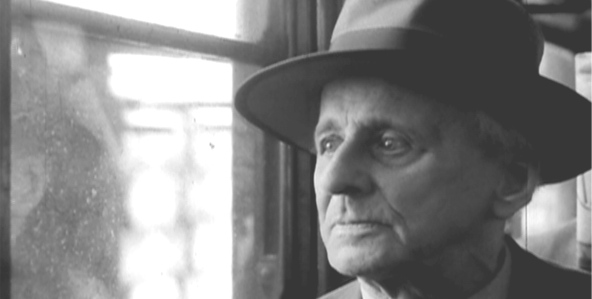
Jay Rosenblatt’s new THE D TRAIN is part of specially curated program at IFC Center

IFC Center
323 Sixth Ave. at West Third St.
Tuesday, October 25, $16, 8:00
212-924-7771
www.ifccenter.com
www.jayrosenblattfilms.com

Last October, former therapist Jay Rosenblatt presented the New York premiere of yet another masterpiece, The Darkness of Day (2009), at MoMA, along with other “long shorts,” “diary films,” and “short shorts” composed primarily of found and archival footage and home movies. For more than thirty years, the San Francisco-based Rosenblatt, who was born in New York, has been making films that examine the human psyche in unique, unusual ways. On October 25, he will host a specially curated selection of his work as part of the IFC Center’s “Stranger than Fiction” series, including The Darkness of Day, Afraid So (2006), Human Remains (1998), King of the Jews (2000), and his latest, The D Train (2011). The Darkness of Day is a twenty-six-minute examination of suicide inspired by the self-inflicted deaths of two people Rosenblatt knew. Using footage rescued from school Dumpsters, he incorporates industrial and educational films about suicide, touching on such well-known cases as the Hemingway family and the first man to jump off the Golden Gate Bridge as well as that of a Japanese woman who leaped into a volcano, setting off a rash of copycats. Beverly Berning and Richard J. Silberg narrate the film, which includes readings from a suicide victim’s journal, in a steady monotone that is a trademark of Rosenblatt’s work. The Darkness of Day is both fascinating and frightening, perhaps the most honest look at suicide we’ve ever seen. In the three-minute Afraid So, Garrison Keillor reads from a poem by Jeanne Marie Beaumont that asks questions that all can be answered by the title while Rosenblatt shows related images; among the questions are “Is this going to hurt?,” “Will it leave a scar?,” “Are you contagious?,” and “Will I have to put him to sleep?” Human Remains, “a film about the banality of evil,” looks at Adolf Hitler, Benito Mussolini, Joseph Stalin, Francisco Franco, and Mao Tse Tung; King of the Jews, “a film about fear and transcendence,” deals with Rosenblatt’s own childhood fear of Jesus; and The D Train chronicles an old man’s life in five minutes. Despite their often very serious subject matter, Rosenblatt’s films are absolutely thrilling to watch, intellectually stimulating, visually vibrant, and emotionally powerful.