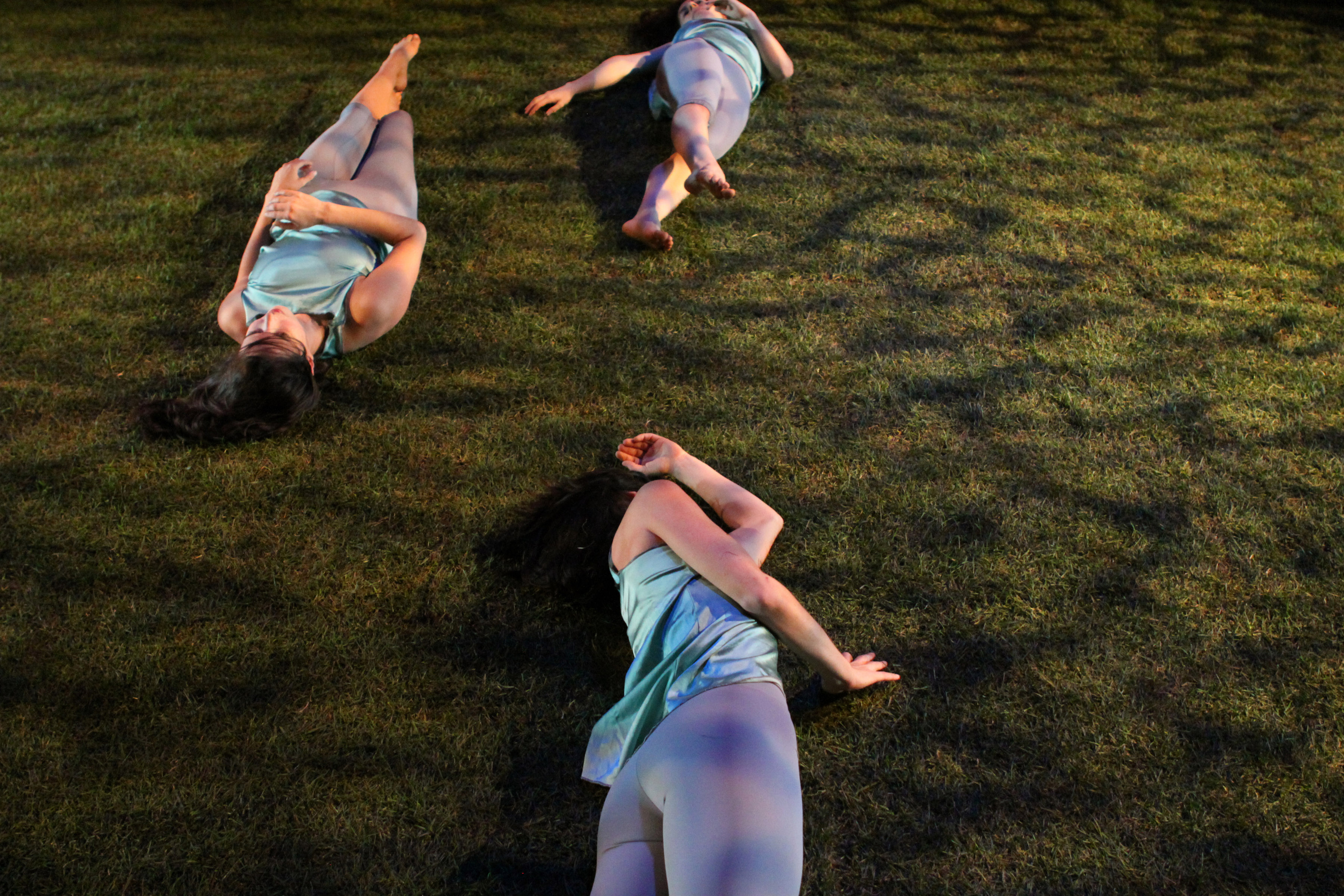
Laura Peterson finds splendor in the grass in WOODEN (photo by Steven Schreiber)
HERE
145 Sixth Ave. at Dominick St.
Through November 12, $20
212-647-0202
www.here.org
www.lpchoreography.com
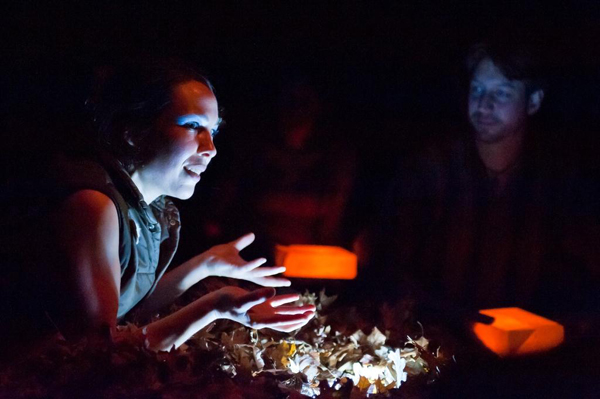
This month several dancer/choreographers have been putting on unique performances in transformed spaces. In SHOW, Maria Hassabi and Hristoula Harakas wound their way across the floor of the Kitchen, right in the middle of the audience. In The Thank-you Bar at New York Live Arts, Emily Johnson/Catalyst invites people through a long corridor into a dark room where they can sit on small cushions and later gather around a kiddie pool filled with leaves. And in Wooden at HERE, Laura Peterson has cut the usual stage in half, with one side covered by live grass that has been turning brown since the run began November 4. Instead of the usual rafters, the audience sits on long wooden benches on a hard white surface amid thick tree branches hanging from the ceiling. Peterson, Kate Martel, Edward Rice, and Janna Diamond move slowly on the grass, gently falling and rolling, Amanda K. Ringger’s lighting casting multiple shadows on the walls. The natural beauty of the piece is enhanced by the intoxicating smell of the outdoors and interstitial, animalistic solos by rotating guest artists Shannon Gillen, Meredith Fages, Luke Gutgsell, and Asimina Chremos in a makeshift hallway. Following an intermission in which the audience must leave the theater, the space is reversed, the benches now on the soft grass, the dancers performing on the harder floor. Whereas the first half, “Ground,” featured beautifully mellifluous organic movement, the second half, “Trees,” is much harsher, the choreography more robotic, the dancers wearing kneepads to protect them as they fall hard to the floor. Soichiro Migita’s sound design changes as well, now more techno-based, blips and beeps replacing the smoother sounds of the first section. Although the general comparison might be obvious, setting the warm, organic environment against a cold, computerized soulless society, and it occasionally does get repetitive, Wooden is a compelling work whose elements are, appropriately, biodegradable. To read our twi-ny talk with Peterson, click here.

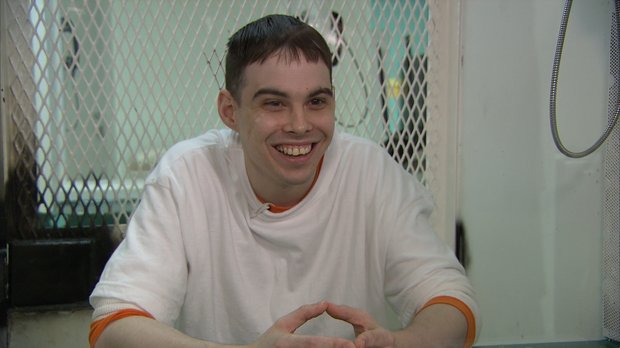
 Upon meeting convicted murderer Michael James Perry on Death Row eight days before the twenty-eight-year-old was going to be executed by the state of Texas, master filmmaker Werner Herzog tells him, “I have the feeling that destiny, in a way, has dealt you a very bad deck of cards. It does not exonerate you, and when I talk to you, it doesn’t necessarily mean that I have to like you, but I respect you, and you are a human being, and I think human beings should not be executed.” After explaining his personal view on capital punishment, Herzog then lets the rest of the compelling documentary Into the Abyss: A Tale of Death, a Tale of Life play out like a police procedural as he investigates how and why two teenage boys murdered three people in October 2001. Herzog opens the film by speaking with Death House chaplain Rev. Richard Lopez in a potter’s field graveyard, then follows that with four sections that detail the crime, the community in which it occurred, and the family members on both sides of the law affected by the grisly, senseless murders. Herzog divides the film into four primary chapters — “The Crime,” “The Dark Side of Conroe,” “Time and Emptiness,” and “A Glimmer of Hope” — as he talks with the often smiling Perry and his cohort, Jason Aaron Burkett; Lt. Damon Hall, who shares the specific aspects of the murders of Sandra Stotler, her seventeen-year-old son, Adam, and Adam’s friend Jeremy Richardson, supplemented by original crime-scene video; Charles Richardson, Jeremy’s older brother; Lisa Stotler-Balloun, Adam’s sister, who has seen more than her fair share of loss; Melyssa Thompson-Burkett, who fell in love with Burkett after he was incarcerated; Delbert Burkett, Jason’s stepfather, who is also behind bars; and Captain Fred Allen, who oversaw executions in the Huntsville prison. Herzog asks penetrating but not leading questions that get the subjects to talk openly and honestly about the crime and its aftermath and their lives in general, many of which seem trapped in a vicious cycle of violence, jail, poor education, and other endless hardships. Into the Abyss is a powerful film that, because of Herzog’s extremely sensitive handling of an extremely controversial topic, is not nearly as polemical or political as it could have been. Into the Abyss, which was the opening-night gala selection of the recent “Doc NYC” festival, opens November 11 at the IFC Center and Lincoln Plaza.