
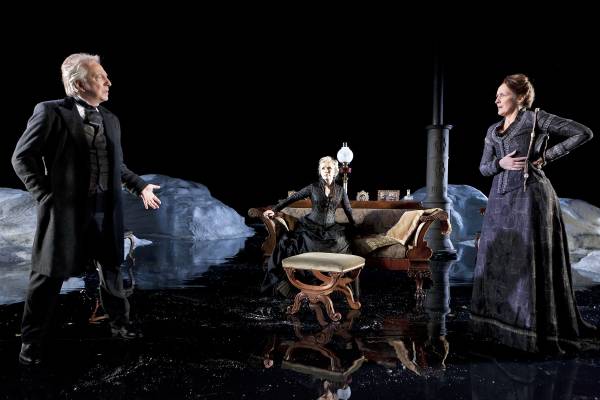
A dysfunctional Connecticut family lets loose in Tommy Nohilly’s BLOOD FROM A STONE (photo by Monique Carboni)
Acorn Theatre, Theatre Row
410 West 42nd St. between Ninth & Tenth Aves.
Through February 19, $61.25
212-239-6200
www.thenewgroup.org
Recalling the long line of such dysfunctional theatrical families as George, Martha, Nick, and Honey from Edward Albee’s WHO’S AFRAID OF VIRGINIA WOOLF? and the Tyrones from Eugene O’Neill’s LONG DAY’S JOURNEY INTO NIGHT, debut writer Tommy Nohilly’s BLOOD FROM A STONE is a flawed but compelling, none-too-subtle, extremely bleak production from the New Group. Nohilly, an actor living in Hell’s Kitchen, sets the play in a working-class home in suburban New Britain, Connecticut, around Christmastime earlier this decade. The prodigal slacker son, military vet Travis (Ethan Hawke), has come home for a few days before planning to take off to find himself out on the open road; ostensibly the voice of reason in the family, he is also a stand-in for the audience; unable to take action, he spends most of his time listening and watching, except when having a quick fling with his married high school sweetheart, Yvette (Daphne Rubin-Vega), who lives next door. Travis’s brother, Matt (Thomas Guiry), is considering leaving his wife and two children for a coworker who is married with four children, while sister Sarah (Natasha Lyonne), the person closest to “normal,” is pregnant again. But the stars of the show are their parents, Bill (Gordon Clapp) and Margaret (Ann Dowd), who are constantly at each other’s throats, screaming, yelling, and cursing, both filled with a hateful venom that feels all too real; this is not a couple that is about to kiss and make up under any circumstance, so don’t expect any Christmas miracles. Clapp is outstanding as Bill, a ticking time bomb ready to explode (or implode) at any moment, while Dowd chews up and spits out Derek McLane’s wonderfully vapid set design. Although Nohilly and director Scott Elliott tend to hit hard — the family’s severe dysfunction is mirrored by the house itself falling apart, with ceiling tiles crashing down as the roof leaks huge splashes of rainwater into the kitchen — there are also moments of great subtlety and tenderness, as when Bill and Travis reminisce over late-night ice-cream cones or Travis almost absent-mindedly massages his sister’s feet. In fact, dairy is a key aspect in the play, as milk, the nourishing substance of youth, is guzzled by several characters over the course of four very tense days. An actor’s writer, Nohilly has created numerous scenes in which the performers shine, although the women are too one-note (the playwright and director even go out of their way to have Rubin-Vega gratuitously run naked across the stage), and the play often feels like a series of vignettes instead of a smooth, continuous narrative, too jumpy and random. It’s also top heavy, with the too-long first act running around an hour and a half, followed by the too-short second act, which clocks in at about forty minutes. Still, there’s a lot to like about this intimate production, which also features fine special effects by Jeremy Chernick.


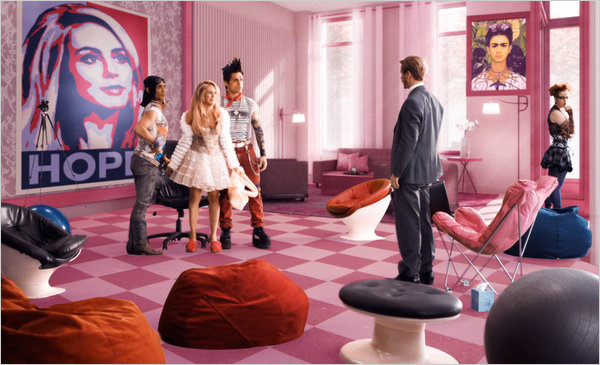
 Cult director Alex Cox, the mastermind behind REPO MAN and SID & NANCY, must have threatened the people running the 2009 Venice Film Festival with a barrage of Growler missiles to get this unwatchable, thoroughly embarrassing piece of pernicious nonsense to be included in the prestigious festival’s competition. This very strange, low-rent satire, made primarily on green screen, is an unbelievably lame supposedly comic thriller about Pixxi De La Chasse (Jaclyn Jonet), a disinherited debutante who gets a job working for a pair of repo men (Miguel Sandoval and Robert Beltran) after her father (Xander Berkeley) and aunt (Karen Black) cut her off because of her penchant for getting arrested. Upon learning of a million-dollar reward for repossessing a long-missing train, Pixxi is determined to prove to her family, her Euro-trash wannabe sidekicks (Danny Arroyo as 666, Jennifer Balgobin as Nevavda, and Zahn McClarnon as Savage Dave), and fellow repo woman and urban legend expert Lola (a nearly unrecognizable Rosanna Arquette) that she can take care of herself, even as terrorists threaten to blow up Los Angeles with Cold War-era Growler missiles if the game of golf isn’t banned. Or something like that. While it’s possible that Cox might have been striving to make one of those so-bad-it’s-good kind of movies, he’s failed at that as well, even dragging Chloe Webb into this disaster. REPO CHICK is in no way a sequel to REPO MAN, but it does bring down its legend ever so slightly, especially when it includes the word “pernicious” in the dialogue, a direct link to the great “pernicious nonsense” line delivered in its awesome predecessor. The lone saving grace is activist singer-songwriter Danbert Nobacon’s “Jamestown 2007” song that plays over the end credits, but you’re better off just checking that out on his record THE LIBRARY BOOK OF THE WORLD. (Nobacon makes a cameo in the film, while Cox illustrated the former Chumbawumba leader’s 2010 book THREE DEAD PRINCES.) REPO CHICK will screen at the IFC Center for one week before being released on Blu-ray and DVD February 8.

 Named Best Documentary at numerous film festivals across the country, MARWENCOL offers a surprising look inside the creative process and the fine line that exists between art and reality. On April 8, 2000, Mark Hogancamp was nearly beaten to death outside a bar in his hometown of Kingston, New York. He spent nine days in a coma and more than a month in the hospital before being released, suffering severe brain damage that has left his memory a blur. To help put his life back together, he began using toys and dolls — Barbies, celebrity replicas, army men — to re-create his personal journey. He makes dolls of his friends and relatives, the people he works with, and others, constructing an alternate WWII-era universe he calls Marwencol, complete with numerous buildings and plenty of Nazis. He captures the detailed story in photographs that are not only fascinating to look at but that also help him figure out who he was and who he can be. This miniature three-dimensional world is reminiscent of the two-dimensional one carefully fashioned by outsider artist Henry Darger in his fifteen-thousand-page manuscript, The Story of the Vivian Girls, in What is known as the Realms of the Unreal, of the Glandeco-Angelinnian War Storm, Caused by the Child Slave Rebellion, which also features an alternate reality involving military battles set amid stunning artwork. Director, producer, and editor Jeff Malmberg makes no judgments about Hogancamp, and asks the same of the audience. In his first full-length film, Malmberg shares the compelling story of a deeply troubled, flawed man suddenly forced to begin again, using art and creativity to bring himself back to life. He speaks with Hogancamp’s mother, his old roommate, the prosecutor who handled his case, and others who are first seen proudly holding the doll Hogancamp made of them. And Malmberg doesn’t turn away from the more frightening aspects of Hogancamp’s daily existence. MARWENCOL is an unforgettable portrait of lost identity and the long road to redemption.