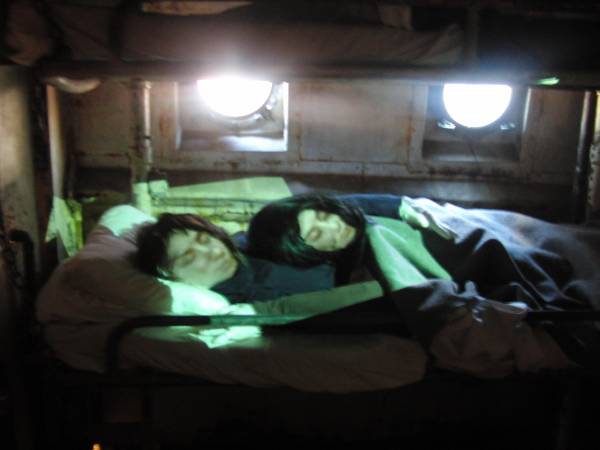
Allison Berkoy will be back on board the Frying Pan in the Lackawanna Caboose with more of her creepy but fun multimedia, lifelike installations (photo by twi-ny/mdr)
Pier 66 Maritime, the Frying Pan
West 26th St. at the Hudson River
March 3-6, $10 (March 4 VIP preview $25)
www.fountainexhibit.com
The sixth annual Fountain Art Fair, dedicated to exhibiting avant-garde works from small, independent galleries, is back on board the Frying Pan, displaying cutting-edge painting, sculpture, and installation from the most radical artists to be found during Armory Week. Following the March 3 VIP and press preview, Fountain will open its doors to the public on Friday at 12 noon with works from such galleries as What It Is, Christina Ray, Microscope, LambertArts, Cheap & Plastique, Temporary States, and, as always, the anarchist Murder Lounge down below (don’t say you weren’t warned), in addition to artists projects by Greg Haberny, Evo Love, Mark Demos, Mami Kotak, and Danni Rash & GILF! There will also be a large-scale street art installation that brings together Chris Stain, Faro, Gaia, Shark Toof, Clown Soldier, Love Me, Ellis G, Alessandro Echevarria, Lee Trice, Imminent Disaster, and Dickchicken!, and Boston’s experimental Mobius Collective will be holding four days of curated roaming and site-specific performance art pieces, called “Infiltrate!,” from Marilyn Arsem and Burns Maxey’s “Captain Burns and First Mate Arsem Discover a New Land” and Sandy and Jeff Huckleberry’s “Entrapment” to Anna Wexler and Catherine Tutter’s “Vessel for Haiti III,” Joanne Rice’s “Without,” and Alisia Lord Louise Waller’s “What Are You, Some Kind of Monster?”
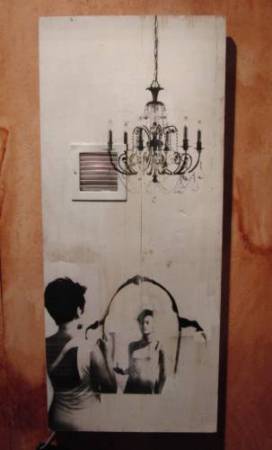
Jason Douglas Griffin’s “We Have an Understanding” can be found at the Leo Kesting booth at Fountain (photo by twi-ny/mdr)
Other special events include an opening-night reception with live performances by Gordon Voidwell, Tecla, and Generic and a Saturday-night Lomography Picture Party with Ninjasonik and NSR, all free with the standard admission price. This year, the show has a decidedly 1980s retro East Village feel; among the highlights are Jason Douglas Griffin’s painted door, “We Have an Understanding,” at Leo Kesting (the spray-painted lightbulb is part of the work but not the heater), Chris Smith’s “Rumblers Road Signs & Rusted Cars” at G-spot’s subtexture booth, JMR’s colorful live mural at Mighty Tanaka, Demos’s lighted, scratched, and pounded glass canvases, Victor Cox’s enticing small works in the enticing Murder Lounge, Carl Gunhouse’s photos of American real estate developments at Camel Art Space, and R. Nicholas Kuszyk’s delightful robot paintings and Morning Breath’s cool collages at McCaig-Welles. One of our Fountain favorites, Allison Berkoy, is back in the Lackawanna railroad car with “Another Night in the Caboose of Magical Light” (she was previously in the caboose in 2009, with Nuala Clarke there last year), a brand-new collection of captivating light and mirror projections that give life to inanimate objects, from dolls and rice to a bowl of soup, all featuring her face. Be sure to explore every nook and cranny of the 133-foot-long lightship, which was in operation from 1930 to 1965 and spent three years underwater before being rediscovered by salvagers. Fountain is the art fair for people who hate art fairs, where anything can happen — and probably will.
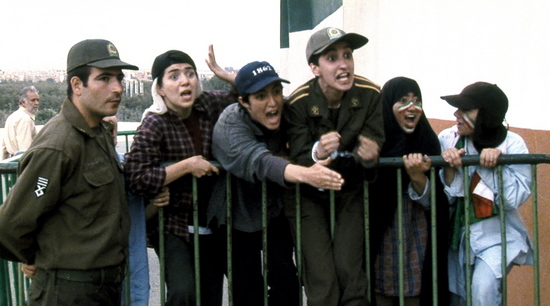
 Filmed on location in and around Tehran’s Azadi Stadium and featuring a talented cast of nonprofessional actors, Jafar Panahi’s Offside is a brilliant look at gender disparity in modern-day Iran. Although it is illegal for girls to go to soccer games in Iran — because, among other reasons, the government does not think it’s appropriate for females to be in the company of screaming men who might be cursing and saying other nasty things — many try to get in, facing arrest if they get caught. Offside is set during an actual match between Iran and Bahrain; a win will put Iran in the 2006 World Cup. High up in the stadium, a small group of girls, dressed in various types of disguises, have been captured and are cordoned off, guarded closely by some soldiers who would rather be watching the match themselves or back home tending to their sheep. The girls, who can hear the crowd noise, beg for one of the men to narrate the game for them. Meanwhile, an old man is desperately trying to find his daughter to save her from some very real punishment that her brothers would dish out to her for shaming them by trying to get into the stadium. Despite its timely and poignant subject matter, Offside is a very funny film, with fine performances by Sima Mobarak Shahi, Shayesteh Irani, Ida Sadeghi, Golnaz Farmani, Mahnaz Zabihi, and Nazanin Sedighzadeh as the girls and M. Kheymeh Kabood as one of the soldiers.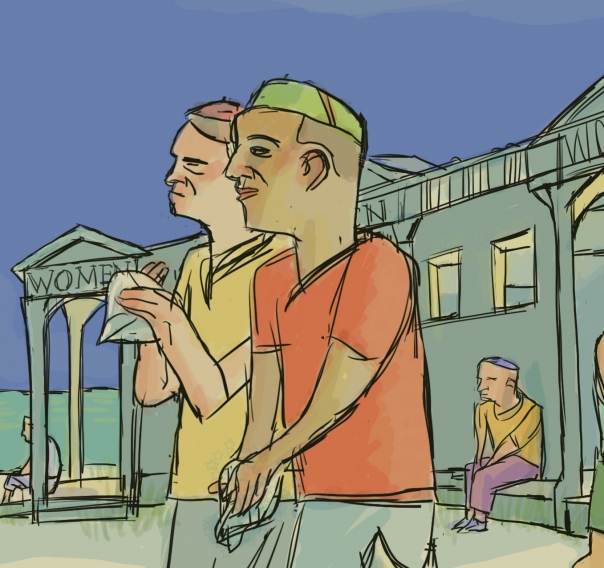
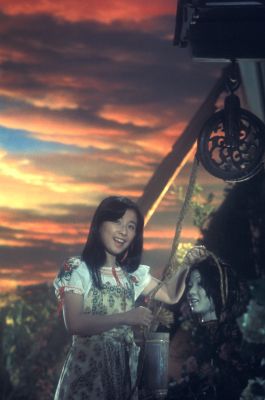
 One of the craziest movies ever made, Nobuhiko Obayashi’s 1977 cult classic, HOUSE (HAUSU), is finally getting its first-ever U.S. theatrical release, in a new 35mm print at the IFC Center. Truly one of those things that has to be seen to be believed, HOUSE is a psychedelic black horror comedy musical about Gorgeous (Kimiko Ikegami) and six of her high school friends who choose to spend part of their summer vacation at Gorgeous’s aunt’s (Yoko Minamida) very strange house. Gorgeous, whose mother died when she was little and whose father (Saho Sasazawa) is about to get married to Ryoko (Haruko Wanibuchi), brings along her playful friends Melody (Eriko Ikegami), Fantasy (Kumiko Oba), Prof (Ai Matsubara), Sweet (Masayo Miyako), Kung Fu (Miki Jinbo), and Mac (Mieko Sato), who quickly start disappearing like ten little Indians. HOUSE is a ceaselessly entertaining head trip of a movie, a tongue-in-chic celebration of genre with spectacular set designs by Kazuo Satsuya, beautiful cinematography by Yoshitaka Sakamoto, and a fab score by Asei Kobayashi and Mickie Yoshino. The original story actually came from the mind of Obayashi’s eleven-year-old daughter, Chigumi, who clearly has one heck of an imagination. Oh, and we can’t forget about the evil cat, a demonic feline to end all demonic felines. The film was released last year prior to its appearance on DVD from Janus, the same company that puts out such classic fare as Federico Fellini’s AMARCORD, Akira Kurosawa’s RASHOMON, Jacques Tati’s M. HULOT’S HOLIDAY, François Truffaut’s SHOOT THE PIANO PLAYER, Jean Renoir’s THE RULES OF THE GAME, and Jean-Luc Godard’s VIVRE SA VIE, so HOUSE has joined some very prestigious company. And who are we to say it doesn’t deserve it?

 Throughout his professional career, which began with the 1997 underground hit Pickpocket, Sixth Generation Chinese writer-director Jia Zhang-ke has shuttled easily between documentaries (Useless, 24 City) and narrative features (The World, Still Life) — and it’s not always obvious which is which, as his steady, poetic style is built on subtlety, slow rhythms, and an innate sense of realism (and he freely mixes fantasy and reality as well). His latest documentary, the Cannes Film Festival Un Certain Regard selection I Wish I Knew, adds elements of fiction to its compelling examination of the intimately personal side effects that resulted from the Chinese civil war and Cultural Revolution, as many people left Shanghai for Taipei and Hong Kong. Jia and interviewer Lin Xudong meet with elderly men and women who tell tragic stories of family and friends being murdered and executed by the government; an especially poignant scene is set at a community gathering where senior citizens dance to Dick Haymes’s version of the old standard “I Wish I Knew”; one of the interviewees sings into the camera, “I wish I knew someone like you could love me / I wish I knew you place no one above me / Did I mistake this for a real romance? / I wish I knew, but only you can answer,” which could be as much about a personal relationship as the revolution itself. Jia also talks with several filmmakers and actresses, from Hou Hsiao-hsien and Wang Toon to Huang Baomei, Rebecca Pan, and Wei Wei, illustrating how Shanghai has been depicted on film with clips from such movies as Hou’s Flowers of Shanghai, Xie Jin’s Huang Baomie, Wang’s Red Persimmon, Lou Ye’s Suzhou River, Wang Bing’s To Liberate Shanghai, Wong Kar-wai’s Days of Being Wild, and Michelangelo Antonioni’s Cina. As the nearly two-hour documentary reaches its conclusion, they interview younger people, including bestselling writer, blogger, and race-car champion Han Han, who don’t share the same conflicted memories of communism and the Cultural Revolution, instead praising an evolving modern-day capitalistic Shanghai that has brought them vast wealth, with no interest in the past of Deng Xiaoping, Mao Zedong, and Chiang Kai-shek. Throughout the film, Jia’s onscreen muse, Zhao Tao, who has appeared in six of his previous works, walks through contemporary Shanghai, pausing as she languidly looks out over the ever-changing city, where intensely poor neighborhoods are being torn down right around the corner from massive construction projects. Commissioned for the 2010 World Expo held in Shanghai, I Wish I Knew might not have been quite what the expo folk expected, but then again, they did give carte blanche to Jia, who never takes the easy way out, creating yet another complex, confusing, and controversial cinematic experience. I Wish I Knew, which is scheduled to open in New York on April 29, is screening as part of MoMA’s “Documentary Fortnight” series, which continues through February 28 with such international nonfiction films as Rick Goldsmith and Judith Ehrlich’s The Most Dangerous Man in America: Daniel Ellsberg and the Pentagon Papers, Linda Hoaglund’s ANPO: Art X War, Helena Trestíková’s Katka, Marcus Lindeen’s Regretters, and Clio Barnard’s The Arbor.