
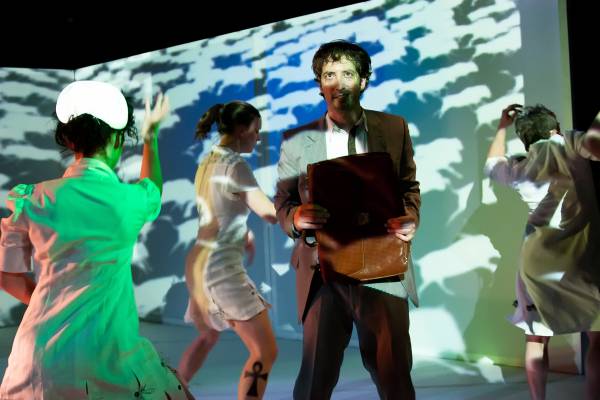
Marie (Marisa Tomei) and Bruce (Frank Whaley) are in for quite a day in Wallace Shawn revival (photo by Monique Carboni)
Acorn Theatre, Theatre Row
410 West 42nd St. between Ninth & Tenth Aves.
Through May 7, $60
212-239-6200
www.thenewgroup.org
This year the New Group is honoring lawyer Fred Wistow and playwright Wallace Shawn at its May 9 gala benefit; in the case of the latter, it can’t be for the current revival of his 1979 show, Marie and Bruce, now playing at the Acorn at Theatre Row. As the audience enters the theater, Marie (Marisa Tomei) is tossing about in bed while her husband, Bruce (Frank Whaley), appears to be sleeping comfortably, setting the stage for what could be a rather tumultuous day in the life of this not-very–happy couple. Soon Marie is addressing the crowd directly, complaining about Bruce; when he eventually wakes up, she lets him have it, spewing curses and telling him how much she hates him. Frank responds by putting on urine-stained pants, making coffee, and somewhat sarcastically repeatedly calling her “darling.” That scene’s not too bad; nor is the ending, when Marie and Bruce discuss their immediate future at a small restaurant. Unfortunately, in between, the bulk of the play takes place at a party that is simply excruciating to watch. The attendees are all seated at a round table that slowly spins as snippets of chatter build up and then fade away, never finishing any thoughts or allowing these minor characters to develop. The audience is left to feel like they’ve paid good money ($60 in this case) to go to a party that doesn’t want them there, filled with people they can’t stand being around. It’s jaw-droppingly offensive and hard not to want to bounce Marie’s epithets right back at Shawn and the director, Scott Elliott. Even if their intent was to make the audience feel uncomfortable — both Shawn and Elliott have not shied away from experimental moments throughout their careers — well, they’ve succeeded beyond their wildest imagination, presenting a production that is impossible to recommend, even to the most masochistic of theatergoers.
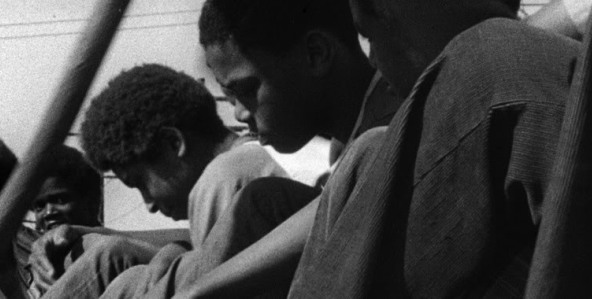
 In 2007, Milestone Films restored and released Charles Burnett’s low-budget feature-length debut, Killer of Sheep, with the original soundtrack intact; the film had not been available on VHS or DVD for decades because of music rights problems that were finally cleared. (The soundtrack includes such seminal black artists as Etta James, Dinah Washington, Little Walter, and Paul Robeson.) Shot on weekends for less than $10,000, Killer of Sheep took four years to put together and another four years to get noticed, when it won the FIPRESCI Prize at the 1981 Berlin Film Festival. Reminiscent of the work of Jean Renoir and the Italian neo-Realists, the film tells a simple story about a family just trying to get by, struggling to survive in their tough Watts neighborhood in the mid-1970s. The slice-of-life scenes are sometimes very funny, sometimes scary, but always poignant, as Stan (Henry Gayle Sanders) trudges to his dirty job in a slaughterhouse in order to provide for his wife (Kaycee Moore) and children (Jack Drummond and Angela Burnett). Every day he is faced with new choices, from participating in a murder to buying a used car engine, but he takes it all in stride. The motley cast of characters, including Charles Bracy and Eugene Cherry, is primarily made up of nonprofessional actors with a limited range of talent, but that is all part of what makes it all feel so real. Killer of Sheep was added to the National Film Registry of the Library of Congress in 1989, the second year of the program, making it among the first fifty to be selected, in the same group as Rebel Without a Cause, The Godfather, Duck Soup, All About Eve, and It’s a Wonderful Life, which certainly puts its place in history in context. Killer of Sheep will be screening at MoMA on April 13 at 4:30 as part of the series “Charles Burnett: The Power to Endure,” which continues through April 25 with such Burnett films as The Glass Shield (1994), The Annihilation of Fish (1999), America Becoming (1991), To Sleep with Anger (1990), and Finding Buck McHenry (2000), among other works, which include such cast members as Ruby Dee and Ossie Davis, Beau Bridges, Danny Glover, Ice Cube, Margot Kidder, James Earl Jones, Lynn Redgrave, Carl Lumbly, Elliott Gould, and Mr. Cub, Ernie Banks.

 Master documentarian Patricio Guzmán’s Nostalgia for the Light is a brilliant examination of memory and the past, one of the most intelligent and intellectual films you’re ever likely to see. But don’t let that scare you off — it is also a vastly entertaining, deeply emotional work that will blow you away with its stunning visuals and heartbreaking stories. Guzmán, who chronicled the assassination of Salvador Allende and the rise of Augusto Pinochet in the landmark three-part political documentary The Battle of Chile, this time visits the Atacama Desert in his native Chile, considered to be the driest place on Earth. Situated ten thousand feet above sea level, the desert is home to La Silla and Paranal Observatories, where astronomers come from all over the world to get unobstructed views of the stars and galaxies, unimpeded by pollution or electronic interference. However, it is also a place where women still desperately search for the remains of their loved ones murdered by Pinochet’s military regime and hidden away in mass graves. In addition, archaeologists have discovered mummies and other fossilized bones dating from pre-Columbian times there. Guzmán seamlessly weaves together these three journeys into the past — as astronomers such as Gaspar Galaz and Luis Hernandez note, by the time they see stars either with the naked eye or through the lens of their massive telescopes, the celestial bodies have been long dead — creating a fascinating narrative that is as thrilling as it is breathtaking. Constructing a riveting tale of memory, Guzmán speaks with architect Miguel Lawner, who draws detailed maps of the Chacabuca desert concentration camp where he and so many other political prisoners were held; Valentina, a young astronomer whose grandparents had to give up her parents in order to save her when she was a baby; archaeologist Lautaro Nunez, who digs up mummies while trying to help the women find “los desaparecidos”; and Victoria and Violeta, who regularly comb the barren landscape in search of their relatives. “I wish the telescopes didn’t just look into the sky but could also see through the earth so that we could find them,” Violeta says at one point. Spectacularly photographed by Katell Dijan, Nostalgia for the Light is a modern masterpiece, an unparalleled cinematic experience that has to be seen to be believed. Hot on the heels of its recent theatrical run at the IFC Center and its inclusion in a BAMcinématek tribute to Guzmán, the film will be showing on April 10, 17, and 24 at Symphony Space as part of the Thalia Film Sundays series.