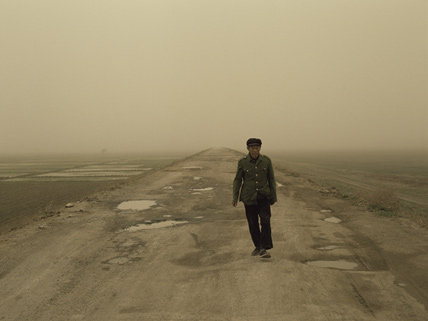
Hai Bo, “Passing Traveler,” pigment print mounted to Dibond, 2009
Pace/MacGill Gallery
32 East 57th St. between Park & Madison Aves.
Tuesday – Saturday through February 26, free, 10:00 am – 6:00 pm
212-759-7999
www.pacemacgill.com
Photographs capture moments in time, but in the large-scale work of Hai Bo, time does anything but stand still. On the wall that greets visitors in the front of the Pace/MacGill Gallery on East 57th St. for the Chinese photographer’s latest solo show, “Shadow — 3” depicts an artist at an easel, looking at a skull on a table in the corner as sunlight streams in. The canvas on the easel is blank as the man contemplates his own life and death. On the other side of the wall hangs “Shadow — 2,” a picture of the same room only without the artist and the easel. Despite their numbered sequence, it is impossible to tell which photograph was taken first, leaving the viewer to wonder whether the artist has not arrived yet, has come and gone, or has succumbed to the ultimate fate of all people. Hai Bo regularly returns to his native village of Changchun in Jilin province, where he photographs old friends and relatives on their passage from life to death. “Their today is our tomorrow,” he tells Stephanie H. Tung in her brief essay in the exhibition catalog. “By showing the loneliness, helplessness, and even despair of these old men, I want to convey the emptiness of success and ambition, and the futility of power and strength.”
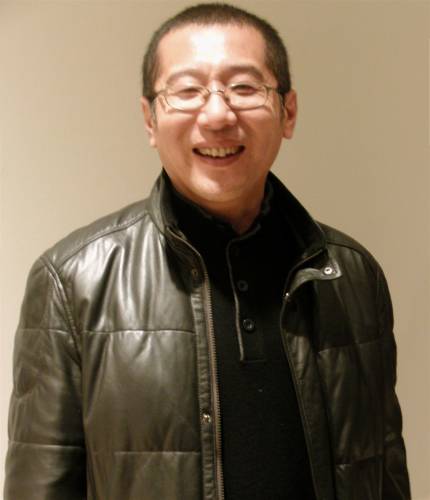
Hai Bo is all smiles at opening of new show about the fleetingness of life (photo by twi-ny/mdr)
In “Old Man,” Hai Bo photographs an eighty-year-old neighbor in a forest in the fall, dead leaves scattered on the ground, surrounded by bare branches as the slightly arched man stands with his head against a tree arching in the opposite direction, his face sullenly pointed downward, at the mercy of the power of nature as his days fade away. In “Smoke,” a group of old men in black, their faces unseen, wander in the snow in front of a homeless shelter, smoke rising from the one-story horizontal structure, their hopes and dreams — and lives — drifting away. In “Passing Traveler,” a sepia-toned photograph shows an elderly man walking up a barren path that dissipates behind him, the wide expanse of his past disappearing in the background, his future brief and uncertain; he is captured midstep, as if teetering on the precipice. Pathways play a central role in a number of the works; in “2007 — I,” a far-off man becomes part of an empty winter landscape, while in “Early Evening Light — 2,” a seated man on one side of a narrow bricked walkway watches two seated men talk on the other side, the fenced-in path running between them and into the distance, where it comes to an end as twilight beckons. Curiously, the only piece that feels out of place is the triptych “Yesterday,” a series of three black-and-white images of two younger men, one holding a cigarette, in the midst of what seems to be a lively, thought-provoking conversation in a darkly lit room, with no outside elements of nature threatening their future. The title evokes an immediacy not evident in the other photographs, which instead focus on the passage of time and approaching death while also revealing a deep, innate respect for and, in humbling ways, a celebration of lives lived.