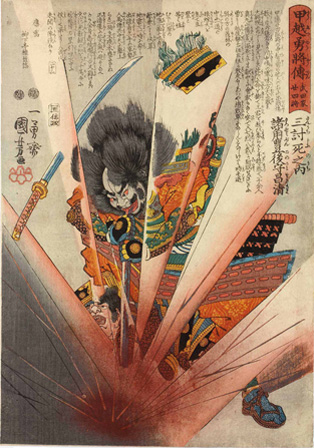
Utagawa Kuniyoshi, “Morozumi Masakiyo Kills Himself in Battle,” color woodblock print, ca. 1848 (photo © Trustees of the British Museum)
JAPANESE PRINTS BY UTAGAWA KUNIYOSHI FROM THE ARTHUR R. MILLER COLLECTION
Japan Society
333 East 47th St. at First Ave.
Through June 13
Admission: $12 (free Friday nights 6:00 – 9:00)
212-715-1258
www.japansociety.org
With the continuing success of manga and graphic novels in the United States, the Japan Society looks back on the career of master visual storyteller Utagawa Kuniyoshi (1797-1861) in “Graphic Heroes, Magic Monsters.” More than 130 color woodblock prints are on view, depicting samurai warriors, elegant women, lush landscapes, kabuki scenes, and comic images. Among the many exciting action-filled vignettes, based on both history and legend, are “Fight on the Roof of Hōryū Tower,” in which Inuzaka Shino tries to single-handedly evade capture by Inukai Kenpachi and his men, and “Ariō-maru Kills a Giant Octopus,” the valiant warrior determined to escape from the clutches of an enormous mollusk. Water figures prominently in many of Kuniyoshi’s pieces; in “Hatsuhana Prays Under a Waterfall,” Hatsuhana prays to a deity for a cure for her warrior husband’s illness, water cascading onto her head and around her body, while in “Three Women with Umbrellas in a Summer Shower,” a trio of women in blue-and-white kimonos playfully avoid a downpour. Kuniyoshi also created peaceful scenes devoid of bloody battles and gruesome characters, including such serene works as “Rainbow at Surugadai,” “Ships Between Maisaka and Arai,” and “Monk Nichiren in the Snow at Tsukahara.”
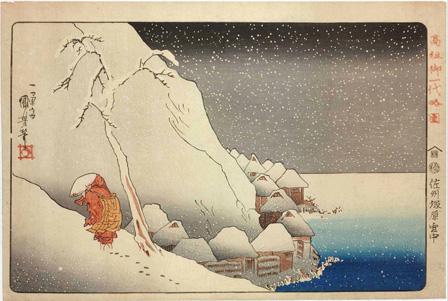
Utagawa Kuniyoshi, “Monk Nichiren in the Snow at Tsukahara,” color woodblock print, ca. 1835 (photo © Trustees of the British Museum)
Kuniyoshi shows off his absurdist sense of humor in such prints as “Sparrows Impersonating a Brothel Scene,” “Kabuki Actors as Turtles,” and “Cats Parodying the Fifty-three Stations of the Tōkaidō.” In the deluxe catalog that accompanies the exhibit, Neil McGregor, director of the British Museum, where the show was a huge hit, writes, “Kuniyoshi was an extraordinarily gifted artist of great versatility, capable by turns of evoking pathos at the doomed fate of a samurai hero, humour with the antics of animals impersonating humans, seduction by feisty-spirited beauties from Japan’s epic past, and calm contemplation of byways in his native city of Edo.” Indeed, Kuniyoshi was a unique and inventive storyteller, displaying immense skill at creating colorful, entertaining, action-packed, and meditative tales. In conjunction with the exhibit, Hiroki Otsuka has created Samurai Beam, a comic book based on Kuniyoshi’s work.