
Lee Kang-do’s (Lee Jung-jin) lonely life takes quite a turn in Kim Ki-duk’s Golden Lion–winning PIETÀ
PIETA (Kim Ki-duk, 2013)
Cinema Village
22 East 12th St. between University Pl. & Fifth Ave.
Opens Friday, May 17
212-924-3363
www.cinemavillage.com
www.drafthousefilms.com
 South Korean auteur Kim Ki-duk’s eighteenth film, Pietà, is not exactly the biblical story of Jesus and Mary. Instead, it’s a challenging, difficult psychological thriller that delves into the relationships between mothers and sons, including the Madonna-whore aspects. Lee Jung-jin stars as Lee Kang-do, a lonely young man who works for a usurer in the slums of Cheonggyecheon who charges local businessmen one-thousand-percent interest on three-thousand-dollar loans. The borrowers are forced to take out insurance policies understanding that if they default on the payments, Lee will maim them, with the resultant claim covering what they owe. In the first half of the movie, Lee makes his way through a series of men who have failed to meet their financial obligations, so he hurts them badly, often in front of their wives or mothers, doing so without guilt or any sign of compassion. A strange woman (Cho Min-soo) starts following him around, ultimately identifying herself as the mother who gave him up for adoption when he was born. Initially, Lee just wants her to go away, but after making her do something unconscionable — and very hard for viewers to watch — in order to prove who she is, they start developing an unusual parent-child relationship, and he begins to reconsider his soulless existence. But this being a Kim Ki-duk film, things don’t necessarily end well for all concerned. Written, directed, and edited by Kim (Bad Guy; Time; Spring, Summer, Fall, Winter . . . and Spring), Pietà, winner of the Golden Lion at the 2012 Venice Film Festival, is an intense cinematic experience that examines truth, justice, family, responsibility, redemption, and revenge as only Kim can.

 Korean auteur Hong Sang-soo continues his fascinating exploration of cinematic narrative in In Another Country, although this one turns somewhat nasty and tiresome by the end. After being duped in a bad business deal by a family member, an older woman (Youn Yuh-jung) and her daughter, Wonju (Jung Yumi), move to the small seaside town of Mohjang, where the disenchanted Wonju decides to write a screenplay to deal with her frustration. Based on an actual experience she had, she writes three tales in which a French woman named Anne (each played by an English-speaking Isabelle Huppert) comes to the town for different reasons. In the first section, Anne is a prominent filmmaker invited by Korean director Jungsoo (Kwon Hye-hyo), who has a thing for her even though he is about to become a father with his very suspicious wife, Kumhee (Moon So-ri). In the second story, Anne, a woman married to a wealthy CEO, has come to Mohjang to continue her affair with a well-known director, Munsoo (Moon Sung-keun), who is careful that the two are not seen together in public. And in the final part, Anne, whose husband recently left her for a young Korean woman, has arrived in Mohjang with an older friend (Youn), seeking to rediscover herself. In all three stories, Anne searches for a lighthouse, as if that could shine a light on her future, and meets up with a goofy lifeguard (Yu Jun-sang) who offers the possibility of sex, but each Anne reacts in different ways to his advances. Dialogue and scenes repeat, with slight adjustments made based on the different versions of Anne, investigating character, identity, and desire both in film and in real life. Hong wrote the film specifically for Huppert, who is charming and delightful in the first two sections before turning ugly in the third as Anne suddenly becomes annoying, selfish, and irritating, the plot taking hard-to-believe twists that nearly undermine what has gone on before. As he has done in such previous films as
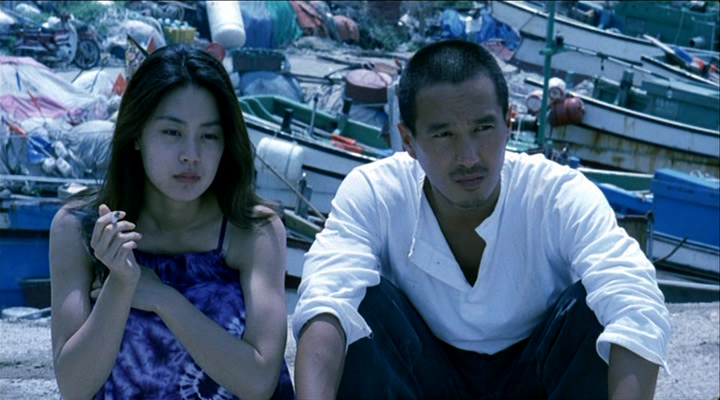
 Kim Ki-duk has made a number of excellent films, but Bad Guy is not one of them. Instead, it’s a preposterous, painfully puerile, and deeply misogynistic movie that is insulting from start to finish. Although it’s only a hundred minutes long, it feels like a thousand. Won Seo stars as Sun-hwa, a college girl who gets conned by Han-ki (Cho Je-hyun) into becoming a prostitute to pay off a false debt. He watches her transformation through a two-way mirror while one of his henchmen, Myung-soo (Choi Duk-moon), thinks he has fallen in love with her himself. Lots of sex and violence ensue, most of which makes no sense and is as unbelievable as the premise. The evening concludes at 7:30 with Kim’s 2008 Dream, a tale in which two people’s dreams intersect.