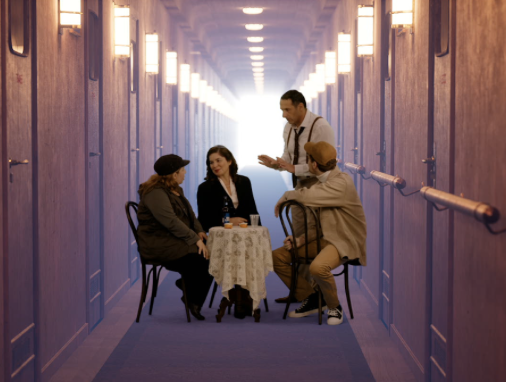
Lauren Elias, Anna Gottlieb, Gene Ravvin, and Nathan Malin discuss antisemitism while on board the virtual MS St. Louis in Witness
WITNESS
Arlekin Players Theatre
Livestreamed select days through January 23, $25
www.arlekinplayers.com/witness
It’s been three quarters of a century since the Holocaust ended, so there are fewer and fewer survivors and witnesses alive to tell the true stories of what happened in the camps of Eastern Europe during WWII. Meanwhile, antisemitism continues to surge around the world amid Holocaust deniers and politicians who misuse and abuse the horror for soundbites and social media memes. Arlekin Players Theatre investigates these issues in its latest interactive online show, Witness. An immersive work that explores antisemitism and desperate migration, the play relates the fate of the MS St. Louis, the German ship that carried more than nine hundred Jewish refugees in May 1939, to the problems of today.
The luxury liner was transporting men, women, and children fleeing the approaching Holocaust, but the ship was turned away by Cuba, Canada, and the United States. Conceived and directed by Arlekin founder and Russian Jewish immigrant Igor Golyak and written by Moscow-based Nana Grinstein with Blair Cadden and Golyak, Witness puts the audience on board the St. Louis, where it begins with a talent show that is based on actual events.
The emcee (Gene Ravvin) believes he is in the present, in a green-screen studio, as he introduces the parade of performers: Liesl Joseph (Esther Golyak) and Gisela Klepl (Elizabeth Sarytchev), who perform “Skating on Glass!” as older versions of themselves (Rimma Gluzman and Polina Vikova) recall Kristallnacht in voice-over; Fritz Buff (Alex Petetsky), who constructs a house of cards and anticipates “joyful days” ahead; Fira (Julia Shikh), who boils a book banned in the USSR; a magician named Marik (Misha Tyutyunik) and his assistant (Jenya Brodskaia); and superheroes Anna (Anna Furman), Olga (Olga Aronova), and Vika (Vika Kovalenko), who call themselves the Elusive Avengers. The audience at home votes on each performance and gains points as they participate.
During each skit, the audience can click on pop-ups to learn more about the contestants, all of whom were real, as well as the actors portraying them. Short biographical sketches include their immigration status and, in the case of the passengers, their fate after the ship was refused entry to America. News crawls onscreen range from the 1930s to the 1990s, which initially confuse the emcee until he figures out what is going on. “The good news is that not only those Jews who left Hamburg in 1939 are sailing with us but also all the Jews that left anywhere are also here,” he explains. “First wave, second wave, third wave. A whole ocean of waves. From USSR, from Germany, from Spain, from Hungary. Yesterday, today, tomorrow, and always. We are all together, ladies and gentlemen. We’re all together. If there is a place to leave, the Jews will find a way.”
After the talent show, the emcee walks through a long, narrow hallway on the ship, encountering people discussing antisemitism, assimilation, the Tree of Life synagogue shooting, dual loyalty, and Israel’s right to exist and defend itself as well as frightening vignettes occurring in some of the cabins. Every word of dialogue is based on interviews Golyak conducted with nearly a hundred people; the narrative is smartly organized to avoid clichés, stereotypical rhetoric, and didactic moralizing.
“So basically what they are is Jews who think if we just bend over a little more, if we just assimilate a little bit better than we did in Germany, that somehow miraculously everything will be different than it was in Germany,” Leah (Lauren Elias) says. “And it’s not going to be. I mean, come on. It feels like the only acceptable party line for Israeli people and Jewish people right now is like, ‘Oh my god. We’re sorry we didn’t all die in World War Two. We know that would have been so much easier for you. We are so sorry for the inconvenience.’”
Joseph (Nathan Malin), talking with Leah and Rachel (Anne Gottlieb) about the public reaction to the real-life stabbing of an Orthodox rabbi in Brighton, admits, “Unless you want to tar yourself as unwanted and as a bad person, you keep your mouth shut and you just duck your head, you know?”
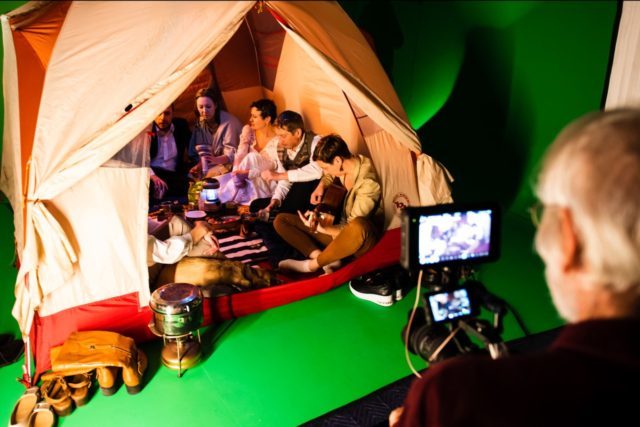
Camera operator Austin de Besche films some of the cast during the making of Witness
Lady Liberty (Darya Denisova) occasionally appears to share her thoughts as the emcee repeats, “This can’t happen here. This can’t happen here!” Leah responds, “No, no, no, it can. And it does.”
Arlekin, which has previously dazzled viewers with the one-woman State vs. Natasha Banina and the daring hybrid chekhovOS /an experimental game/ (featuring Jessica Hecht and Mikhail Baryshnikov), a pair of livestreamed interactive shows that pushed the boundaries of online productions, again breaks new ground through its Zero Gravity (zero-G) Virtual Theater Lab with Witness. Set designer and costumer Anna Fedorova, virtual designer Daniel Cormino, sound designer Viktor Semenov, and director of photography and editor Anton Nikolaev make it feel like it’s all taking place on board the St. Louis, with rolling waves and flying birds outside as the ocean liner heads toward its supposed destination.
During the talent show, the audience on the ship looks like ghosts, which in essence is what they are today. At one point, the screen goes dark for several minutes as binaural recordings play through your headphones, as if you’re a passenger, not knowing what’s coming next, or from where. It sent chills through my bones.
As always with Arlekin’s works, each presentation is followed by a talkback in which members of the cast and crew delve into the making of the work, although Golyak is careful not to give away too many secrets. Some of the discussions include experts on antisemitism and the Holocaust, and the audience is encouraged to share experiences in the lively chat. The night I saw Witness, numerous people (including me) described instances of antisemitism they have encountered. At Yad Vashem, the Holocaust Remembrance Center in Jerusalem, it is noted, “Bearing witness, so they will know, until the last generation.” A compelling and necessary piece of sociopolitical documentary theater, Witness reminds us all just how important that is.
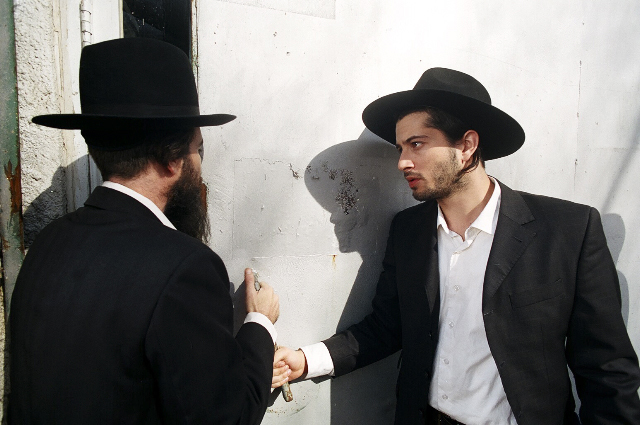
 After his father dies, Aaron (Zohar Shtrauss) decides to keep the family butcher shop going, even taking on a mysterious apprentice, Ezri (Ran Danker), who has arrived in Jerusalem with nowhere to stay and no money. Rumors swirl throughout the tight-knit Orthodox community about Ezri’s past, but Aaron refuses to get rid of him — and soon finds himself unusually attracted to the young gay student. As he fights his desires and tries to keep the burgeoning relationship a secret from his family, his wife (Tinkerbell) starts suspecting something is wrong, and everything he has built threatens to fall apart. A festival favorite at Cannes, Toronto, Karlovy Vary, and last month’s New York Jewish Film Festival at Lincoln Center, EYES WIDE OPEN is a subtly beautiful examination of forbidden love flying in the face of religious belief. Shtrauss portrays Aaron with an awkward uncomfortability that reveals his character’s painful inner struggle and complex moral dilemma, while Danker infuses Ezri with a quiet power. First-time director Haim Tabakman and screenwriter Merav Doster keep things slow and steady all the way, avoiding genre clichés and grandiose statements in favor of a gentle, compelling narrative that never hits you over the head.