Tag Archives: Ohad Naharin

LOVE AND JEALOUSY: SEVEN SCENES AT LITTLE ISLAND

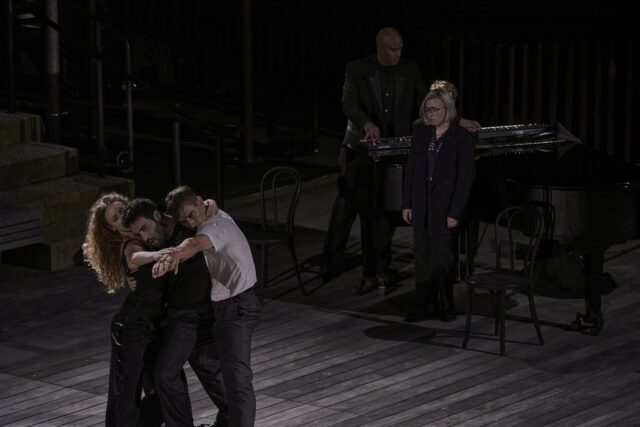
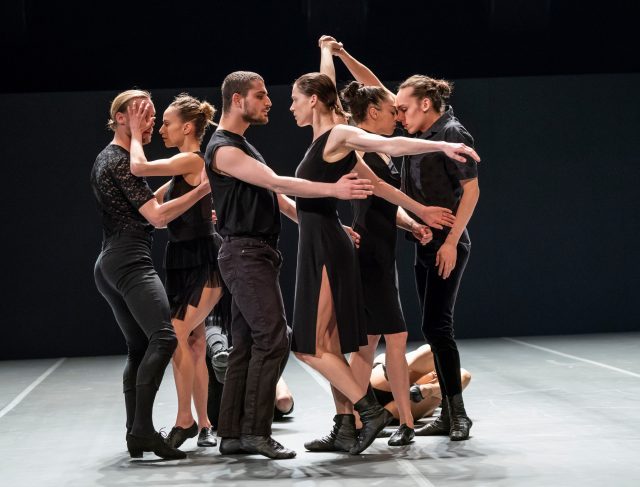
Miriam Gittens, Doug Letheren, and Alexander Bozinoff form a trio as Mikael Darmanie plays the piano and Danni Lee Parpan watches in Seven Scenes at Little Island (photo by Matthew Placek)

SEVEN SCENES
The Amph at Little Island
Pier 55, Hudson River Park at West Thirteenth St.
August 22-28, $10 standing room, $25 seats, 8:30
littleisland.org

A pair of real-life and professional partners bring an infectious passion to Seven Scenes, a lovely hourlong work continuing at the simultaneously spacious yet cozy outdoor Amph at Little Island through August 28.

The dance theater piece was conceived, choreographed, and directed by the Iowa-born Bobbi Jene Smith and Jerusalem native Or Schraiber, who met while dancing for Ohad Naharin’s Batsheva Dance Company, became founding members of the American Modern Opera Company in 2017, got married in 2018, and have a child together. The score, ranging from classical to country, is performed live by the electro-pop duo Ringdown, consisting of real-life couple Caroline Shaw and Danni Lee Parpan on vocals, keys, and synths, accompanied by Mikael Darmanie on keyboards and electronics, Keir GoGwilt on violin, and Coleman Itzkoff on cello. Smith and Schraiber are joined by dancers Alexander Bozinoff, Jonathan Frederickson, Payton Johnson, Doug Letheren, and Ophelia Young.

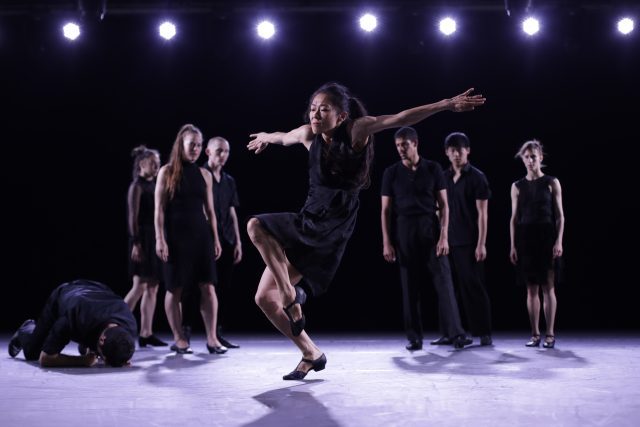
Seven Scenes comprises a series of interconnected vignettes about love, jealousy, and sexual exploration. Victoria Bek’s costumes feature the men in black or gray dress pants, black or white shirts, and shiny black shoes while the women, each with long hair, wear dark, low-cut outfits. The instruments are at the Hudson River end of the bare wood stage, which remains otherwise empty save for a few moments when the cast brings out a table and chairs. Shaw, Parpan, GoGwilt, and Itzkoff occasionally wander around the dancers, singing and playing their instruments before taking seats in the first row in between audience members. Whenever someone is not performing, they are closely watching what is going on, as if they are voyeurs waiting for their moment to participate.

Payton Johnson, Miriam Gittens, and Bobbi Jean Smith line up in Seven Scenes at Little Island (photo by Matthew Placek)

The evening is highlighted by solos, pas de deux, and trios in which the performers enact primarily romantic scenarios to a score that begins with Jean-Louis Duport’s Étude No.7 and then ranges from Brahms’s Piano Trio No. 2 in C major, op.87: andante con moto, Bach’s Violin Sonata in E minor P. 85: I. Allegro, Schubert’s Piano Trio No. 2 in E-Flat Major, D. 929: II. Andante con moto, and Handel’s Keyboard Suite No. 1 (Set II) in B-Flat Major HWV 434 IV. Minuet to Willie Nelson’s “Crazy” and Ringdown’s “Hocket,” “Fantasia,” and “Thirst,” highlighted by guttural sounds.

Smith and Schraiber’s movement language is inspired by Naharin’s Gaga, focusing on the full body, from fingers to toes, interspersed with just a few runs, jumps, and throws; dancers often remain in place as they interact with one another, but the relationships are always powerfully dynamic. (You can find out more about Smith and Schraiber in the films Bobbi Jene and Aviva.) A man and a woman converge, then are interrupted by a second man, the first man interested in both of them. The three women form a line, moving in unison before breaking free.

Classical ballet and ballroom meld with contemporary dance as the men sit around a table, put on and take off jackets, and one of the men stretches across the table. The men later form a row before sitting in chairs, evoking Naharin’s Minus 16 and Jerome Robbins’s bottle dance from Fiddler on the Roof. Individuals fall to the floor and remain there, as if having been rejected, or exhausted by the chase. Johnson excels in a solo to “Thirst” as Ringdown sings, “Clenched jaw and furrowed brow / If you are the rain, then I am the ground / Don’t know what to do with this thirst for a time and place where I found you first / Where I found you first.”

The men shake hands with audience members. Near the end, Fredrickson thrills with a yearning solo to Darmanie’s gorgeous piano.

There’s a beautiful intimacy to Seven Scenes and how it tells its stories, weaving in sound and motion, dancers and musicians, both physically and emotionally, as bodies come together and are ripped apart, all under a glowing night sky.

Following select performances, the audience is invited to the nearby Glade for a free concert at 10:00, with GoGwilt and pianist Conor Hanick on August 27 and pianist Jeremy Denk on August 28.

[Mark Rifkin is a Brooklyn-born, Manhattan-based writer and editor; you can follow him on Substack here.]
BATSHEVA DANCE COMPANY: HORA

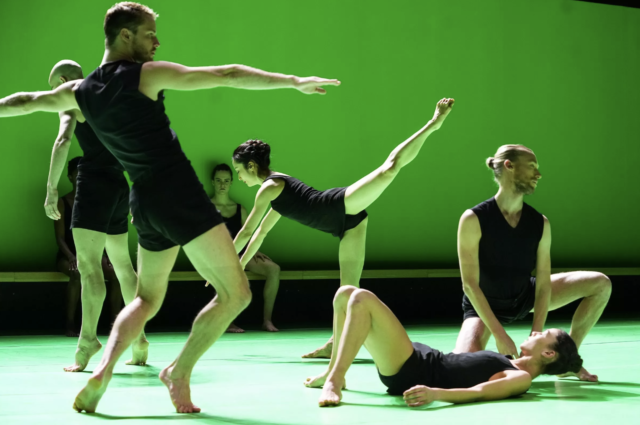
Batsheva Dance Company brings Hora back to New York in two-week Joyce engagement (photo by Steven Pisano)

HORA
The Joyce Theater
175 Eighth Ave. at 19th St.
February 28 – March 12, $10-$75
212-691-9740
www.joyce.org
www.batsheva.co.il

Next year is the one hundredth anniversary of the Jewish circle dance known as the Hora, created by Baruch Agadati in Palestine in 1924, influenced by Romanian and Greek traditions. The dance is a staple of Jewish American weddings and bar and bat mitzvahs, usually accompanied by the folk song “Hava Nagila” and including the lifting of various celebrants on chairs. The Tel Aviv–based Batsheva Dance Company is paying tribute to that centennial by bringing back former artistic director and current house choreographer Ohad Naharin’s sixty-minute Hora, continuing at the Joyce through March 12.

When the 2009 piece came to BAM in 2012, I called it “a mesmerizing experience, a stunning balance of light, color, sound, and movement from one of the world’s most innovative and entertaining choreographers.” It is just as mesmerizing today.

Batsheva and Naharin have dazzled us with such other pieces as Deca Dance, Three, Minus 16, Project 5, Venezuela, and Last Work; this return to Hora is a welcome one, even if the required mask-wearing muffles some of the audience’s exhilarated gasping.

Naharin’s Hora features no chairs and no “Hava Nagila”; it takes place in an empty rectangular space bordered on three sides by a green wall, with a long bench (designed by Amir Raveh) in the back where the eleven dancers sit when not dancing. Isao Tomita’s electronic score incorporates such familiar sounds as Richard Strauss’s “Also Sprach Zarathustra,” Richard Wagner’s “Tannhauser: Overture” and “Die Walküre: Ride of the Valkyries,” Charles Edward Ives’s “The Unanswered Question,” Claude Debussy’s “Prelude to the Afternoon of a Faun,” Modest Mussorgsky’s “Catacombs,” and a whistled version of John Williams’s main theme from Star Wars. (The sound design and editing is by Maxim Waratt.)

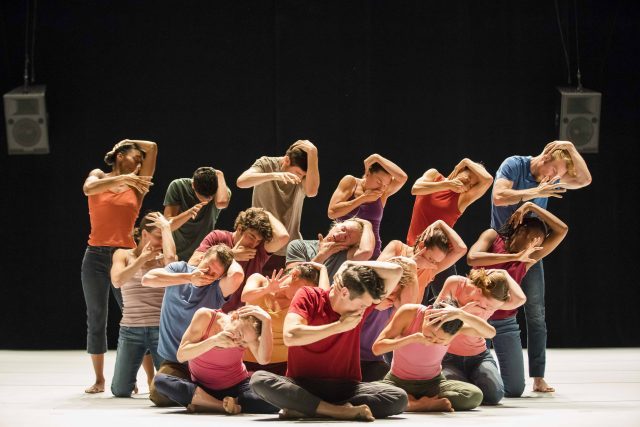
The show starts with the eleven dancers rising from the bench and approaching the front of the stage, set and lighting designer Avi Yona Bueno initially casting them in silhouette. It is one of only a few times the performers will move in unison; they break out into solos and other configurations, seldom coming into contact with one another as they proceed in Batsheva’s unique Gaga language, ranging from sharp, angular gestures to nearly impossible formations that resemble animals, insects, and even animated video game characters. I’m still trying to figure out how Ohad Mazor touched his foot to his elbow.

There are also dazzling moments from Eri Nakamura (who designed the black costumes), Billy Barry (undulating on the floor), Sean Howe (repeatedly hitting himself in the head), Londiwe Khoza, Matan Cohen, Chiaki Horita (gyrating her torso) — well, the entire company, which also includes Chen Agron, Yarden Bareket, Yael Ben Ezer, Guy Davidson, Ben Green, Li-En Hsu, Adrienne Lipson, Gianni Notarnicola, Danai Porat, Igor Ptashenchuk, and Yoni (Yonatan) Simon, who all display a thrilling physicality, testing the boundaries of what the human body could, and should, do.

When all eleven dancers are off the bench, it is hard to know where to focus your attention, as they are all doing different things; if you follow a cartwheel, you might miss a trio rolling over the floor or a duo balancing against each other’s buttocks. To watch the entire troupe at once is to get absorbed in a kind of whirlwind of life in all its unpredictability and excitement. But no matter where you look, prepare to be amazed.

BATSHEVA DANCE COMPANY: VENEZUELA

(photo by Stephanie Berger)

Batsheva’s Venezuela offers chills and thrills at BAM (photo by Stephanie Berger)

BAM Howard Gilman Opera House
Peter Jay Sharp Building
230 Lafayette Ave.
March 27-30, 7:30
718-636-4100
www.bam.org
batsheva.co.il/en

Batsheva’s Venezuela is yet another exhilarating must-see work from one of the world’s most adventurous and exciting companies. Running March 27–30 at the Howard Gilman Opera House, the evening-length piece, which doesn’t overtly reference the titular, troubled South American nation in its narrative, consists of two forty-minute sections. In the first part, the Israeli troupe moves as a group, breaks into energetic solos and daring duets, skips around with delight, and lines up at the front of the stage, each dancer stepping forward one at a time as two men rap Biggie’s NSFW “Dead Wrong” (“The weak or the strong / who got it goin’ on / You’re dead wrong”). The women ride the men like donkeys. In a blur, the cast, all dressed in black (the costumes are by dancer Eri Nakamura), briskly skip from one side to the other, some moving forward, some backward, chaos threatening but soon replaced by a childlike wonder. The music primarily consists of Gregorian chants until a growing drone overtakes everything and the lights go out.

(photo by Stephanie Berger)

Batsheva dancers repeat themselves in dazzling ways in Ohad Naharin’s Venezuela at BAM (photo by Stephanie Berger)

The lights come back on and there are different dancers now onstage, and for the next forty minutes they perform the exact same choreography, only to a different soundtrack (including songs by Rage Against the Machine, Olafur Arnalds, and Vox; the lush soundtrack design and edit is by Maxim Waratt) and with different lighting by Avi Yona Bueno (Bambi), offering an enchanting perspective on what choreographer Ohad Naharin showed us in the first half, his Gaga movement language telling a new story. Even the blank cloths that were dropped in the first section now become colorful symbols. The first Batsheva work to come to New York since former company dancer Gili Navot took over as artistic director from Naharin, who is now house choreographer, Venezuela is another triumph from a scintillating company that has been enriching dance and dazzling audiences for decades.

VENEZUELA

(photo by Asca)

Batsheva’s Venezuela dances into BAM this week (photo by Asca)

BAM Howard Gilman Opera House
Peter Jay Sharp Building
230 Lafayette Ave.
March 27-30, 7:30
718-636-4100
www.bam.org
batsheva.co.il/en

Superstar Israeli troupe Batsheva Dance Company is back at BAM this week with Ohad Naharin’s Venezuela, running March 27-30 at the Howard Gilman Opera House. The evening-length work consists of two forty-minute sections that mirror each other movement-wise but change the score, which ranges from Gregorian chants to songs by Rage Against the Machine, Olafur Arnalds, the Notorious B.I.G., and Vox. Under Naharin’s leadership, Batsheva has been presenting dance at BAM for many years, including The Last Work, Hora, and Sadeh21; this will be the main troupe’s first visit since former company dancer Gili Navot took over as artistic director, with Naharin remaining as house choreographer to develop new pieces and continue his research into his unique Gaga language. Venezuela, which addresses freedom of choice and has been percolating in Naharin for decades, is performed by Etay Axelroad, Billy Barry, Yael Ben Ezer, Matan Cohen, Ben Green, Chiaki Horita, Chunwoong Kim, Rani Lebzelter, Hugo Marmelada, Eri Nakamura, Nitzan Ressler, Kyle Scheurich, Maayan Sheinfeld, Yoni (Yonatan) Simon, Hani Sirkis, Amalia Smith, Imre van Opstal, and Erez Zohar, with lighting by Avi Yona Bueno (Bambi), soundtrack design and edit by Maxim Waratt, and costumes by Nakamura. On March 29 at 10:30 am at the Mark Morris Dance Center, a Batsheva company member will lead a Gaga and Repertory master class for professionals ($25).

HUBBARD STREET DANCE CHICAGO: DECADANCE

(© Todd Rosenberg Photography)

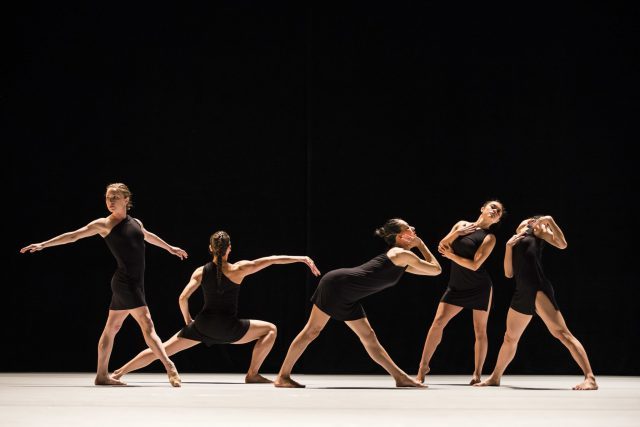
Hubbard Street Dance Chicago performs Ohad Naharin’s Anaphase as part of Decadance/Chicago at the Joyce (© Todd Rosenberg Photography)

The Joyce Theater
175 Eighth Ave. at 19th St.
March 6-17, $10-$80
212-242-0800
www.joyce.org
www.hubbardstreetdance.com

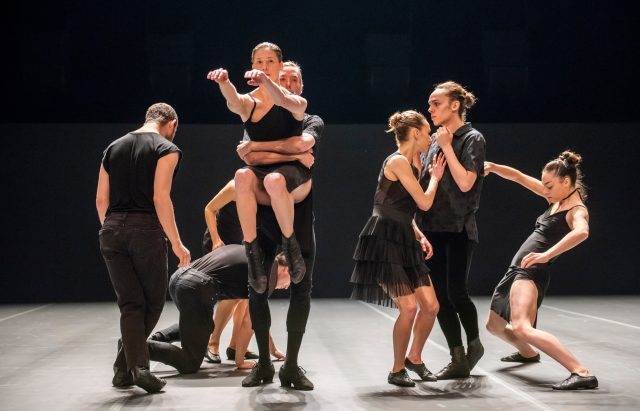
Hubbard Street Dance Chicago’s Decadance/Chicago is an exhilarating evening of invigorating motion and sound, energetically performed by the talented Illinois troupe, returning to the Joyce for the first time in four years. The piece consists of excerpts from nine works by Israeli choreographer Ohad Naharin and Batsheva Dance Company, a kind of evolving greatest-hits package. The evening opens with a tall young man in somewhat Hasidic garb, instructing us to turn off our cellphones in a very serious tone of voice. When the second act begins, he asks the audience a series of questions that get rather personal. Both introductions immediately work to create an intimate, quirky, magical space for the performers and audience to inhabit. The sixteen-person company, each one worthy of singling out — Craig D. Black Jr., Jacqueline Burnett, Rena Butler, Alicia Delgadillo, Kellie Epperheimer, Michael Gross, Elliot Hammans, Alysia Johnson, Myles Lavallee, Adrienne Lipson, Florian Lochner, Ana Lopez, Andrew Murdock, David Schultz, Kevin J. Shannon, and Connie Shiau — exhibits Naharin’s Gaga movement language, “which emphasizes the exploration of sensation and availability for movement,” resulting in a unique and identifiable vocabulary that offers dancers chances to improvise amid the complex structures.

(© Todd Rosenberg Photography)

Hubbard Street Dance Chicago kicks off Decadance/Chicago at the Joyce with Max (© Todd Rosenberg Photography)

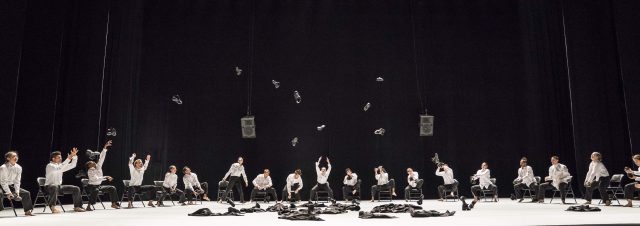
Staged by Ian Robinson and Rachael Osborne so that several of the excerpts flow smoothly into the next, Decadance/Chicago highlights the upper body at the start, particularly the arms and hands, as dancers come together and break off into solos. They rarely slow down as they move to Dick Dale’s “Hava Nagila,” Goldfrapp’s “Train,” Arvo Pärt’s “Fur Alina,” Marusha’s “Somewhere over the Rainbow,” Ali Hassan Kuban’s “Mabrouk Wo Arisna,” Dean Martin’s “Sway,” the Beach Boys’ “You’re Welcome,” and a woman reciting Charles Bukowski’s 1972 poem “making it,” the last with poetic cumulative choreography for five women. The company lines up at the front of the stage as the dancers suddenly burst into brief solos; they break into three groups and play a game of horse as each dancer either copies the previous one or dares the proceeding one to match them; the cast ventures into the audience and grabs partners to dance with onstage; and then they bring out the showstopping Anaphase, in which fifteen performers are arranged in a semicircle of chairs and remove their Hasidic garb (black pants, white shirt, black jacket, and black hat) to Naharin and Tractor’s Revenge’s adaptation of the traditional Passover song “Ehad Mi Yodea,” a dazzling display that leaves the audience breathless.

The excerpts range from 1993’s Anaphase — which I have now seen three times, the first by Batsheva, then by Alvin Ailey, in which I was one of the audience members brought onstage, and now by Hubbard Street, with my wife getting chosen to dance, and it has been a joy on each occasion — to 2011’s Sadeh21 and also include Zachacha, Naharin’s Virus, Three, Telophaza, George & Zalman, Max, and Seder. Experiencing Naharin’s choreography performed by this young, high-energy, spectacularly gifted company makes for an electrifying evening that’s not to be missed. Decadance/Chicago continues through March 10, to be followed March 12-17 by HSDC’s versions of a trio of works by Canadian choreographer and Kidd Pivot founder Crystal Pite, A Picture of You Falling, The Other You, and Grace Engine, all with music by Owen Belton. Batsheva fans can catch Naharin’s Venezuela March 27-30 at BAM.

HUBBARD STREET DANCE CHICAGO: OHAD NAHARIN / CRYSTAL PITE

(© Todd Rosenberg Photography)

Hubbard Street Dance Chicago will perform works by Ohad Naharin and Crystal Pite during two-week season at the Joyce (© Todd Rosenberg Photography)

The Joyce Theater
175 Eighth Ave. at 19th St.
March 6-17, $10-$80
212-242-0800
www.joyce.org
www.hubbardstreetdance.com

Hubbard Street Dance Chicago returns to the Joyce for the first time in four years with an exciting two-week season of two fab programs. From March 6 to 10, the company, which celebrated its fortieth anniversary last year, will put its own spin on Ohad Naharin’s Batsheva favorite, Decadance, an evolving greatest-hits-like presentation featuring excerpts from multiple works. Decadance/Chicago consists of nearly two hours of sections from such Naharin pieces as Minus 16, Virus, Three, George and Zalman, Max, Anaphase, and Seder. There will be a Curtain Chat at the March 7 performance. From March 12 to 17, HSDC brings a trio of works by Canadian choreographer and Kidd Pivot founder Crystal Pite, A Picture of You Falling, The Other You, and Grace Engine, all with music by Owen Belton. HSDC is led by artistic director Glenn Edgerton; the members of the company are Craig D. Black Jr., Jacqueline Burnett, Rena Butler, Alicia Delgadillo, Kellie Epperheimer, Michael Gross, Elliot Hammans, Alysia Johnson, Myles Lavallee, Adrienne Lipson, Florian Lochner, Ana Lopez, Andrew Murdock, David Schultz, Kevin J. Shannon, and Connie Shiau. Tickets are going fast, so you best not wait if you want to catch this hot troupe in action.

NAHARIN’S VIRUS: BATSHEVA — THE YOUNG ENSEMBLE

Batsheva’s Young Ensemble will perform Naharin’s Virus at the Joyce July 10-22 (photo Photo © Ascaf)

Batsheva’s Young Ensemble performs Naharin’s Virus at the Joyce through July 22 (photo © Ascaf)

The Joyce Theater
175 Eighth Ave. at 19th St.
July 10-22, $10-$86
212-242-0800
www.joyce.org
batsheva.co.il/en

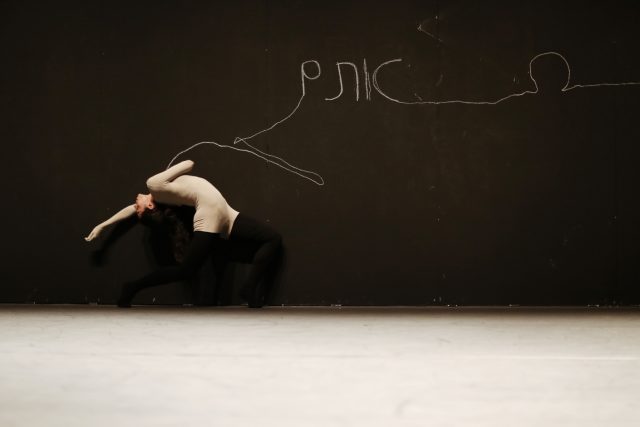
“Language! It’s a virus!” multidisciplinary artist Laurie Anderson declares in her 1986 song “Language Is a Virus.” Batsheva Dance Company artistic director Ohad Naharin uses his trademark Gaga movement language to infectious triumph in his 2001 piece Naharin’s Virus, which has now been adapted for Batsheva – The Young Ensemble, trimmed down to a relatively lean sixty minutes and continuing at the Joyce through July 22. Don’t be scared off by the term “Youth Ensemble”; the large troupe of seventeen dancers and two apprentices are enthusiastic and energetic, well-trained performers — with many very likely to soon graduate to the senior company. As the crowd enters the theater, an inflatable white sky dancer swirls above its fan, a sly introduction to what is to follow: A female dancer traces parts of her body with chalk as she moves awkwardly along a blackboard at the back of the stage; Evyatar Omessy stands on a platform in a rigid suit, reciting text inspired by Peter Handke’s confrontational 1966 play, Offending the Audience, which places the viewer in uncomfortable contrast to the performer; dancers in unflattering, tight beige and black costumes form a row up front and break out into improvised, aggressive solos; performers share brief, intimate tales about their life and jump onto and hang from the blackboard, on which they have written words and phrases that evoke what is happening in the world today.

The show changes slightly from performance to performance, as dancers improvise in certain sections and can write and draw whatever they want on the blackboard, but one large word must be included, running the length of the board: “Plastelina,” the Hebrew word for “playdough” as well as a purposeful misspelling of Palestine, a reference to Naharin’s politics, which have been critical of the Israeli government’s treatment of the Palestinian people. In addition, the work features Arab folk music by Shama Khader, Habib Allah Jamal, and Karni Postel, along with snippets of Samuel Barber, Carlos D’Alessio, P. Stokes, and P. Parsons. However, Naharin’s Virus is not meant to be controversial but instead a celebration of, among other things, ambiguity. “In the spirit of collaboration, Naharin’s Virus brings together the work of an Israeli-American choreographer, an Austrian writer, Arab and Israeli musicians, and dancers from around the world,” Naharin explains in a program note. “Even and especially in these divided times, the work reminds us that dance can act on universal ethics to create sublime moments that we could not have created alone.” In “Language Is a Virus,” Anderson explains, “Paradise / is exactly like / where you are right now / only much much / better”; with this new, updated version of Naharin’s Virus, Naharin has created another unique kind of paradise.