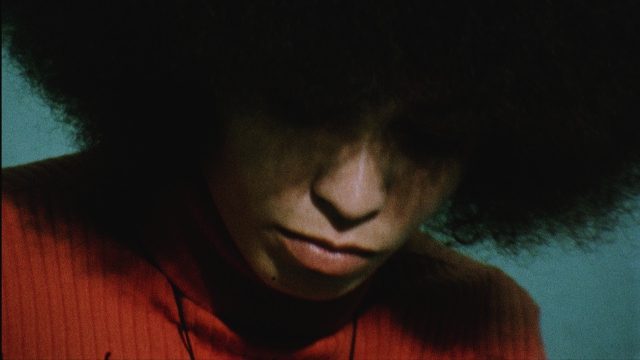
Angela Davis speaks out about the Black Power movement in compelling documentary that kicks off IFC Center Summer of Resistance series
THE BLACK POWER MIXTAPE 1967-1975 (Göran Hugo Olsson, 2011)
IFC Center
323 Sixth Ave. at Third St.
Monday, May 8, 8:00
212-924-7771
www.ifccenter.com
www.blackpowermixtape.com
 From 1967 to 1975, a group of more than two dozen Swedish journalists came to America to document the civil rights movement. More than thirty years later, director and cinematographer Göran Hugo Olsson discovered hours and hours of unused 16mm footage — the material was turned into a program shown only once in Sweden and seen nowhere else — and developed it into The Black Power Mixtape 1967-1975, a remarkable visual and aural collage that focuses on the Black Panthers and the Black Power movement, a critical part of American history that has been swept under the rug. Olsson and Hanna Lejonqvist have seamlessly edited together startlingly intimate footage of such seminal figures as Eldridge Cleaver, Bobby Seale, Huey P. Newton, Dr. Martin Luther King, Jr., and Stokely Carmichael, including a wonderfully personal scene in which Carmichael interviews his mother on her couch. But the star of the film is the controversial political activist Angela Davis, who allowed the journalists remarkable access, particularly in a jailhouse interview shot in color. (Most of the footage is in black-and-white.) Davis also adds contemporary audio commentary, sharing poignant insight about that tumultuous period, along with Abiodun Oyewole of the Last Poets, singer Erykah Badu, professor, poet, and playwright Sonia Sanchez, Roots drummer Ahmir Questlove Thompson (who also composed the film’s score with Om’Mas Keith), and rapper Talib Kweli, who discusses specific scenes in the film with a thoughtful grace and intelligence. The Black Power Mixtape 1967-1975 is an extraordinary look back at a crucial moment in time that has long been misunderstood, if not completely forgotten, and has taken on new relevance with the rise of the Black Lives Matter movement. The film kicks off the IFC Center series “Queer/Art/Film: Summer of Resistance” on May 8 at 8:00 and will be followed by a discussion with fierce pussy, the New York City-based queer women artists collective. The monthly series, in which activists and political collectives select films to screen and discuss, continues on June 26 with Deborah Esquenazi’s Salem: the Story of the San Antonio Four, chosen by F2L, July 24 with Susana Aikin and Carlos Aparicio’s The Salt Mines & The Transformation, with Bianey Garcia, and August 14 with Niazi Mostafa’s A Glass and a Cigarette, with Tarab NYC.
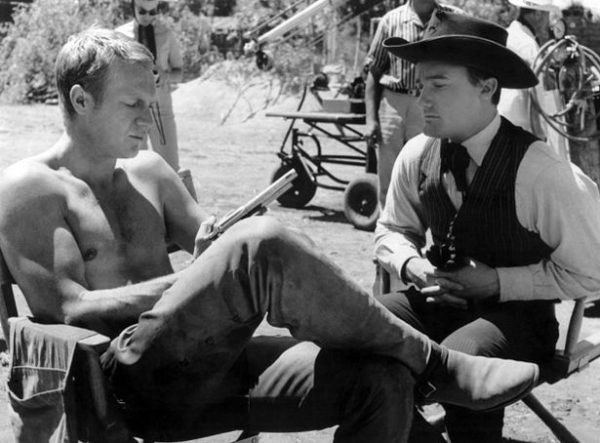
 “He was a very special friend, and I’ll always miss his unique way of looking at life,” Robert Vaughn wrote of Steve McQueen in his 2008 memoir, A Fortunate Life. The longtime pals made three films together, the first being John Sturges’s classic Western, The Magnificent Seven. (They also each got their start in low-budget sci-fi cheese, McQueen in The Blob and Vaughn in Teenage Cave Man.) The film, a remake of Akira Kurosawa’s 1954 epic Seven Samurai, features Vaughn, fresh off an Oscar nomination for Best Supporting Actor in The Young Philadelphians, and McQueen, who was in the middle of his run as Josh Randall in the television series Wanted: Dead of Alive, playing two of seven sharpshooters hired by the men in a poor Mexican farming village where a group of bandits led by the evil Calvera (Eli Wallach) have been running roughshod. McQueen is Vin Tanner, a cool drifter, while Vaughn is traumatized Civil War sharpshooter Lee; the other five are Yul Brynner as leader Chris Adams, Brad Dexter as fortune hunter Harry Luck, James Coburn as knife slinger Britt, Charles Bronson as pro Bernardo O’Reilly, and Horst Buccholz as the fiery young Chico. Brynner and McQueen famously went after each other in a hotly contested battle of acting one-upmanship even as their characters work together to save the town. The magnificent film, which was shot on location in Mexico and established McQueen as a star, also boasts an unforgettably American score by Elmer Bernstein.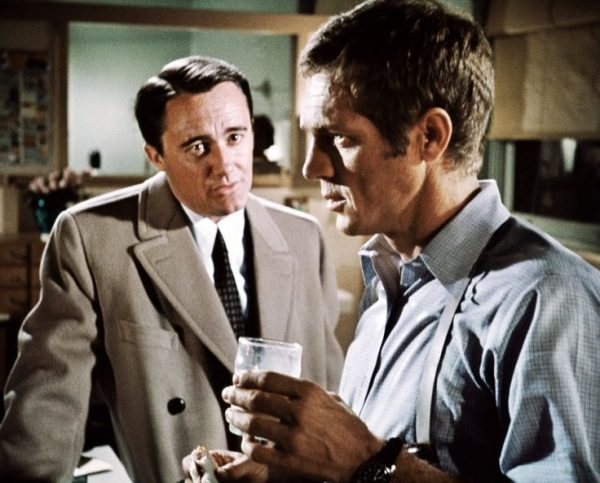
 New York City native Robert Vaughn, who passed away in November at the age of eighty-three, and good friend Steve McQueen, who was only fifty when he died in 1980, reunited onscreen in 1968 for the police-political thriller Bullitt. By then, each had starred in a television series — McQueen in Wanted: Dead or Alive, Vaughn as Napoleon Solo in the wildly successful, Emmy-nominated spy fave The Man from U.N.C.L.E. In Bullitt, McQueen virtually created the Hollywood antihero, playing a cool, calm cop who does things his way, often leaving a mess behind him; meanwhile, Vaughn began establishing himself as the manipulative high-class villain. In Bullitt, which was based on Robert L. Fish’s 1963 novel, Mute Witness, McQueen stars as San Francisco detective Lt. Frank Bullitt, a character inspired by real-life SF inspector Dave Toschi. Bullitt is personally selected by local politician Walter Chalmers (Vaughn) to protect an important witness, who is scheduled to testify against the Organization in forty hours. But things go awry, leading to murder and mayhem — and one of the all-time-great movie car chases — as Bullitt, distrustful of Chalmers, refuses to follow protocol. Shot on location by cinematographer William A. Fraker on the winding streets of San Francisco, the film, directed by Peter Yates and featuring a jazzy score by Lalo Schifrin, has quite a supporting cast, with Don Gordon and Carl Reindel as two members of Bullitt’s team, Simon Oakland as their boss, Norman Fell as a suspicious captain, Jacqueline Bisset as Bullitt’s designer girlfriend, Georg Stanford Brown as a doctor, Paul Genge and Bill Hickman as the hit men, Vic Tayback as the brother of the informant, and Robert Duvall as taxi driver.
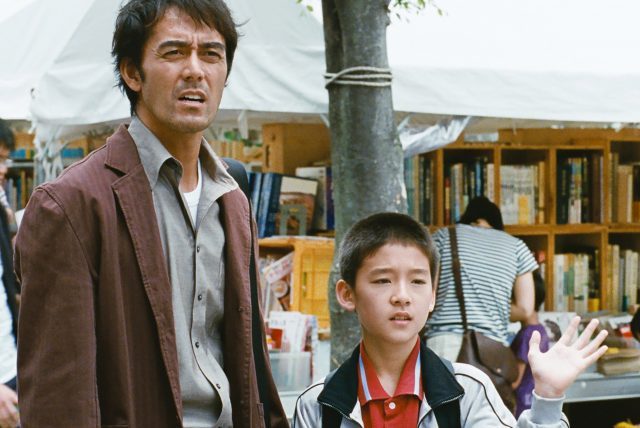
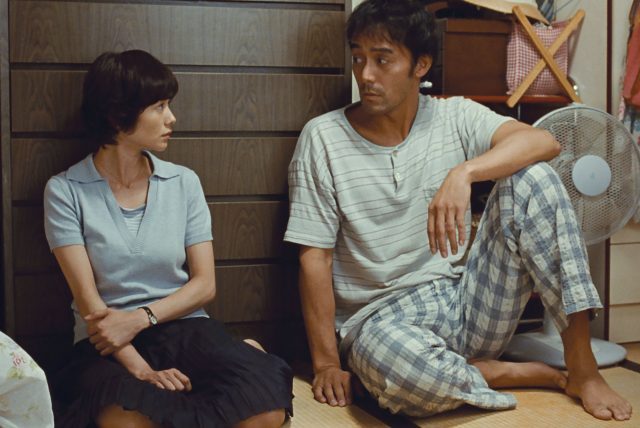
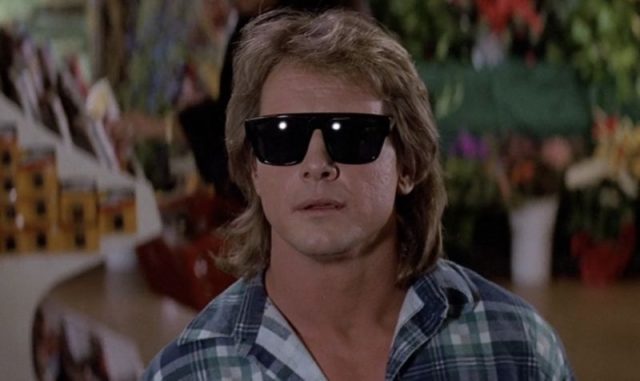
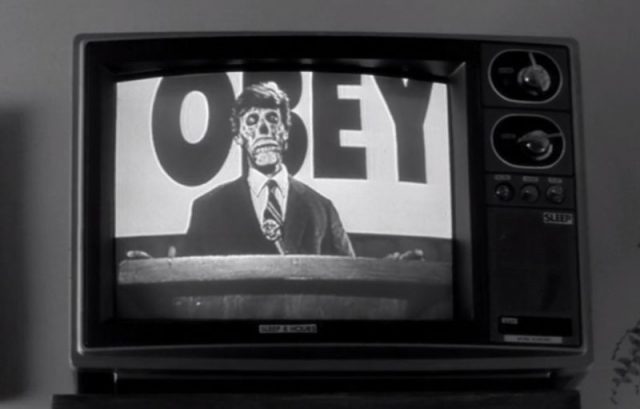
 How can you possibly not love a movie in which wrestling legend Rowdy Roddy Piper, brandishing a shotgun and standing next to an American flag, declares, “I have come here to chew bubblegum and kick ass . . . and I’m all out of bubblegum.” IFC Center’s Trump-inspired “Autocratic for the People: An Unpresidented Series of Star-Spangled Satires” continues March 17-19 with John Carpenter’s tongue-in-cheek Reagan-era cult favorite, They Live. In the goofy 1988 political sci-fi thriller, Piper, who passed away in 2015 at the age of sixty-one, stars as John Nada, a drifter who arrives in L.A. and gets a job working construction, where he is befriended by Frank Armitage (Keith David), who is otherwise trying to keep to himself and away from trouble as he makes money to send back to his family. Frank invites John to stay at a tent city for homeless people, across the street from a church where John soon finds some disturbing things happening involving a blind preacher (Raymond St. Jacques), a well-groomed man named Gilbert (Peter Jason), and a bearded weirdo (John Lawrence) taking over television broadcasts and making dire predictions about the future. John then discovers that by using a pair of special sunglasses, he can see, in black-and-white, what is really going on beneath the surface: Alien life-forms disguised as humans have infiltrated Los Angeles, gaining positions of power and placing subliminal messages in signs and billboards, spreading such words and phrases as Obey, Consume, Submit, Conform, Buy, Stay Asleep, and No Independent Thought. John seeks help from Frank and cable channel employee Holly Thompson (Meg Foster), determined to reveal the hidden conspiracy and save the planet.