Tag Archives: ifc center

DOC NYC: SKY AND GROUND

Sky & Ground

Sky and Ground follows a refugee family on a frightening journey trying to find a new home

SKY AND GROUND (Talya Tibbon & Joshua Bennett, 2017)
Sunday, November 12, SVA Theatre, 333 West 23rd St. between Eighth & Ninth Aves., $19, 6:45
Thursday, November 16, IFC Center, 323 Sixth Ave. at West Third St., $12, 10:15 am
Festival runs November 9-16 (various passes $75-$750)
www.docnyc.net
www.humanityonthemove.org

The DOC NYC festival, consisting of more than 150 nonfiction feature films and shorts, has room for stories small and large, allowing viewers to understand the world from the macro to the micro; Talya Tibbon and Joshua Bennett’s Sky and Ground, having its world premiere November 12 and 16, zeroes in on the micro. In his sweeping new documentary, Human Flow, Chinese artist and activist Ai Weiwei and his crew went to twenty-three countries and dozens of refugee camps to personalize the growing international migrant crisis. Among the places he visited was the Idomeni tent city in Greece at the now-closed Macedonian border. The makeshift camp is the starting point for Tibbon and Bennett’s startling and intimate Sky and Ground. Tibbon embeds herself with the Nabi clan, led by Abdullah Sheik Nabi, known as Guevara for his childhood admiration for Argentine rebel Che Guevara. Guevara and his family have escaped the dangerous situation in Aleppo, Syria, and are trying to get to Berlin, where Guevara’s brother, Abdo, lives. But getting there is a harrowing journey, fraught with police and military, rewards for citizens who turn them in, cheating smugglers, and more impediments to their attempts to find a new home. “If we stay here in this misery, my family will go crazy,” Guevara says of the camp, and they are soon back on the road, not knowing what fate awaits them. Using the GPS on his cell phone and staying in touch with Abdo, Guevara has taken charge because no one else could, accepting responsibility for his mother, Jalila; his sister, Shireen, and her husband, Souleiman; and his nieces and nephews. The film plays out like a gripping thriller as the family sneaks through vast landscapes, wooded areas, isolated camps, and train stations, knowing they could get caught and sent back to war-torn Syria at any moment. “Everywhere I go, I lose my home,” Shireen says, while Jalila adds, “I am very, very regretful. I’d rather have bombs dropping every day than go through this torment.” But Guevara never gives up, no matter how treacherous things become. “After trying to get in touch with ten smugglers, all of them proved to be liars and frauds,” he explains. “We have no choice but to attempt to smuggle ourselves again.”

The arresting film is beautifully photographed by Emmy winner Axel Baumann, the lush vistas and sunsets in stark contrast to the Nabis’ heart-wrenching dilemma. In addition, Guevara documents everything he can using his cell phone and a handheld camera given to him by the crew. Tibbon and Bennett, who are also two of the producers — Guevara is credited as one of the coproducers — puts the viewer right in the midst of the action, helping us understand the Nabis’ strife and fear. They could be a middle-class family from anywhere; they are not poor and uneducated but an intelligent and clever group with money and connections and yet still are thwarted at nearly every turn, though they manage to maintain their faith and even their sense of humor throughout. There is a fascinating, unspoken aspect to Sky and Ground that went on behind the scenes; the filmmakers might have embedded themselves with the Nabis, but they had access to a car and slept in hotels as they followed the family across several countries. “As a filmmaker, ‘embedding’ with your subjects poses moral and editorial dilemmas on a daily basis,” Tibbon notes in her director’s statement. “When Jalila, the family matriarch, wondered why we couldn’t get them a car (or put them in ours), or when the kids asked why do I get to go back to a hotel at the end of the evening and they don’t, I didn’t have good enough answers. They weren’t criminals and I wasn’t better than them. . . . But from the outset we knew we couldn’t do anything illegal (like sneaking through borders) and we also knew that we didn’t want to do anything that would potentially put the family at risk or alter their journey.” Sky and Ground is a terrifying film to watch not only because it is hard to know what we as free individuals can do about the crisis but also because in today’s situation across the globe, it makes you realize that this could happen to just about anyone. Part of the Humanity on the Move trilogy from Show of Force, Sky and Ground is screening on November 12 at 6:45 at the SVA Theatre and November 16 at 10:15 am at IFC Center, followed by Q&As with Tibbon, Bennett, and producers Maro Chermayeff and Jeff Dupre.

DOC NYC: MOLE MAN

Mole Man

Ron Heist shares his love of building in DOC NYC world premiere, Mole Man

MOLE MAN (Guy Fiorita, 2017)
Friday, November 10, Cinépolis Chelsea, 260 West Twenty-Third St. at Eighth Ave., 212-691-5519, $19, 7:30
Monday, November 13, IFC Center, 323 Sixth Ave. at West Third St., $12, 12:15
Festival runs November 9-16 (various passes $75-$750)
www.docnyc.net
www.facebook.com

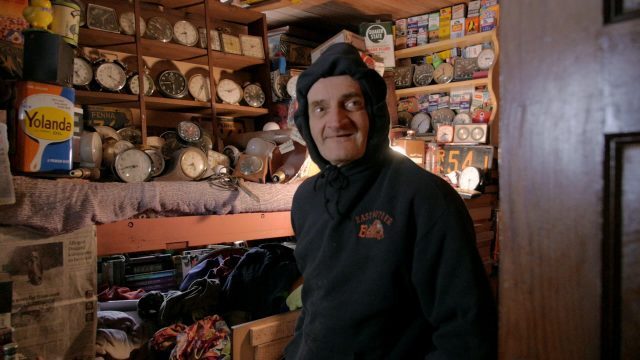
After appearing on a 2010 episode of the History Channel series American Pickers, Ron Heist gained cult status for the massive structure he had been building in his parents’ large backyard in Butler, Pennsylvania, since 1965. The director of that episode, Guy Fiorita, has now made the bittersweet documentary Mole Man, a fascinating look inside the life and times of a unique man. Born in 1950, Ron has been obsessed with building things since he was a child. Now sixty-seven, toothless, and usually wearing a dark hoodie, Ron has constructed twenty-five buildings and twenty-three cellars linked by narrow passageways on his family’s property. He built it all by hand and by himself, scavenging items from more than seven hundred abandoned homes and factories, many of which had been left vacant following the closing of the Pullman Standard railcar plant in 1982. He refuses to use nails or mortar or even a level, relying on his own feel and intuition. He gets on his motorcycle, puts on his helmet, and meanders through the woods until he finds these houses, then brings back wood, doors, window frames, cinder blocks, chests, and whatever else he can fit on the back of his bike, as well as balls, plungers, clocks, license plates, and other items he collects. “People shouldn’t be as wasteful,” he says while showing off some treasures he has just found. Ron was always different, and his father, Chuck, treated him special; but the film’s real subject is Ron’s prospects: following the recent death of his father, Ron is left with his ninety-year-old mother, Mary, and his future becomes doubtful. The family, including Ron’s brother, Tim, and sister, Christine, who love Ron dearly, think that their mother would be better off in a smaller home, and they don’t have enough money to maintain the house. Meanwhile, they finally get Ron tested by a therapist to confirm that he has autism — he was previously diagnosed as “mentally challenged,” as were many of a lost generation of undiagnosed adults with the condition — and might be eligible for certain health benefits, although they worry about what might happen to Ron if he has to live elsewhere. “His routine, his environment . . . that’s his safety zone,” Tim says. But when Ron tells three of his friends, Sean Burke, Mike, and his cousin-in-law, John Burkert, that he knows where the Piney Mansion is, they believe they might find more than enough valuable objects, particularly some old, classic cars, to keep Ron living at home, so off into the woods they go, on a rather difficult journey. “To see Ron pulled out of that place, I think, would kill him, plain and simple,” John explains. “I just don’t think he’d want to live anymore.”

Mole Man

Mole Man Ron Heist picks up materials and brings them back home on his motorcycle

Ron is an endearing, eminently likable character. He has a childlike enthusiasm and even somewhat resembles a taller version of the Mole Men from the 1951 Superman film, although that’s not where he got his nickname from. “He loves being the Mole Man,” Burkert says. Like many people with autism, he has trouble holding conversations unless it’s on a subject that interests him, like time, numbers, construction, and scavenging. People naturally are drawn to his love of life and his dedication to his ever-expanding living quarters, although safety issues are a growing concern. Fiorita never exploits Ron, instead celebrating his individuality while also recognizing that Ron’s immediate future is at risk. Mole Man is having its world premiere at DOC NYC on November 10 and 13, with Fiorita, producers Cassidy Hartmann and James DeJulio, and some of the film’s subjects participating in postscreening Q&As. DOC NYC runs November 9 to 16 at Cinepolis Chelsea, the SVA Theatre, and IFC Center, with more than 150 features and shorts, by such documentarians as Barbara Kopple, Errol Morris, Laura Poitras, and Heidi Ewing and Rachel Grady; the films highlight such diverse figures as Eric Clapton, Curtis Sliwa, Lorraine Hansberry, Sammy Davis Jr., and David Bowie in addition to exploring many contemporary sociocultural issues from around the world.

THE SQUARE

The Square

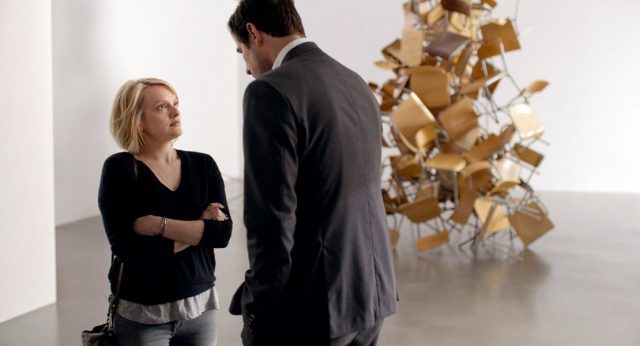
Ann (Elisabeth Moss) and Christian (Claes Bang) discuss more than just art in Ruben Östlund’s The Square

THE SQUARE (Ruben Östlund, 2017)
IFC Center, 323 Sixth Ave. at West Third St. 212-924-7771
Film Society of Lincoln Center, Walter Reade Theater, 165 West 65th St. at Amsterdam Ave., 212-875-5601
www.squarethefilm.com

The plot of Ruben Östlund’s 2014 absurdist satire, Force Majeure, turns on a man’s momentary act of surprising cowardice when an avalanche threatens him and his family at a ski resort. In the Swedish writer-director’s latest film, the Palme d’Or-winning absurdist satire The Square, the plot is set in motion when a man’s momentary act of surprising bravery leads him into a spiral of personal and professional chaos. The Tesla-driving chief curator of the fictional X-Royal contemporary art museum in Sweden, Christian (Claes Bang) is walking through a busy plaza when he hears a woman crying for help as bystanders do nothing. After his initial hesitation, Christian intervenes and is ultimately quite pleased with himself and his decision to do the right thing — until, a few moments later, he realizes he’s been robbed. Back at the museum, Christian listens to a pair of millennial marketers pitching their campaign for the institution’s upcoming exhibit, “The Square,” which is highlighted by a four-meter-by-four-meter square positioned on the cobblestones in the museum’s front courtyard. An accompanying plaque reads, “‘The Square’ is a sanctuary of trust and caring. Within it we all share equal rights and obligations.” As the museum contemplates a cutting-edge ad campaign for the exhibit, Christian has to deal with an arts journalist, an angry kid, the museum board, and his own moral decisions.

The Square

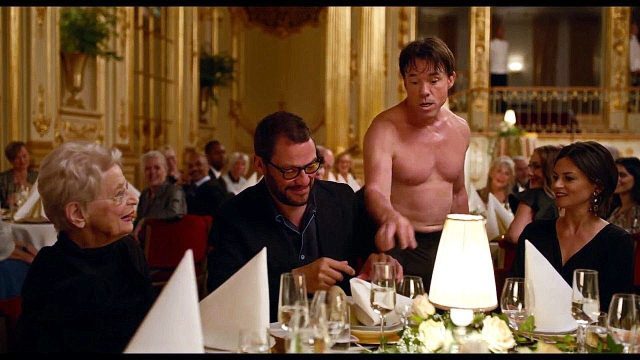
Oleg (Terry Notary) takes performance art to another level in The Square

The film opens as Christian is being interviewed by Ann (Elisabeth Moss) in a gallery, in front of a neon wall sign that says, “You have nothing.” Later, the sign says, “You have everything.” This dichotomy is central to Christian’s inner dilemma; he seemingly does have everything, but his world is slowly shattering, just like the artworks heard crashing to the ground later while he is in a deep personal discussion with Ann. Östlund skewers the art world, political correctness, class conflict, freedom of speech, privileged social groups, and the concept of “safe spaces” in the film, which was inspired by a real exhibition by Östlund and producer Kalle Boman that ran at the Vandalorum Museum in Sweden in 2015. Immediately following the opening interview, which reveals Ann has no feel whatsoever for contemporary art, workers remove the statue of King Karl XIV Johan that stands in front of the museum; on the base is his royal motto, “The love of the people my reward.” As the monument is being taken off its plinth, the crane drops it and the king’s head falls off. “The Square” takes its place, signaling the old being replaced by the new, physical objects replaced by lofty ideals, with an utter disregard for what has come before. Östlund (Involuntary, Play) is not above making such obvious analogies and references, including naming his protagonist Christian, a man who spends much of the film attempting to do what he considers the right thing. (Östlund, who also edited the film with Jacob Secher Schulsinger, has said that “The Square” installation is a place where the Golden Rule and the Universal Declaration of Human Rights should take precedence.)

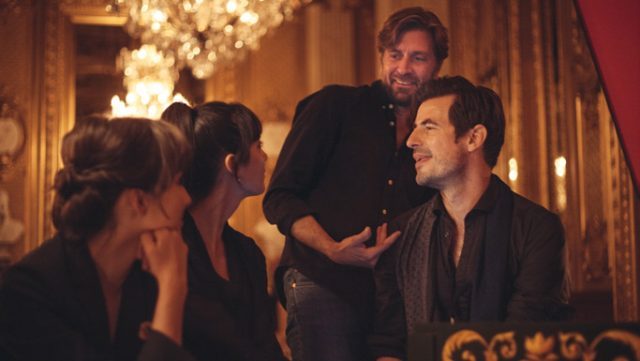
Wriet-director Ruben Östlund (standing) on the set of The Square

Writer-director-editor Ruben Östlund (standing) on the set of The Square

The film focuses on the issue of trust, and particularly how humans lose their ability to have faith in others as they mature. At the entrance to the “Square” installation, visitors are given the option of deciding between two paths, one marked “I Trust People,” the other “I Mistrust People.” Christian’s two daughters both take the former. The older daughter is a cheerleader, showing trust in her teammates as the girls are tossed high in the air and wait to be caught — but not without several men hovering right behind them to try to prevent any possible falls. The difference between childhood and adulthood is also evident in how Christian deals with a determined young boy in trouble because of the divorced curator. Bang is stoic as Christian, a man who feels more at home among works of art than with other people. He wants so desperately to be good, but it’s getting harder and harder to make the right decision in the current politically correct atmosphere, and he is so self-absorbed that he even fights over possession of a used condom, in one of the film’s most bizarrely comic moments. Those choices come to the fore in two wildly uncomfortable scenes involving an American artist named Julian (Dominic West), first at a public Q&A where he is bedeviled by an audience member with Tourette syndrome, and later at a gala fundraiser where a bare-chested performer (motion-capture actor Terry Notary) moves around the luxurious room, acting like an ape, but as he begins breaking physical and socially acceptable boundaries, no one knows how to react. (His acting like an ape is in direct contrast to Ann’s roommate, an ape who is far more civilized and is never commented on.) Both situations frustrate the viewer as well, as we are as hamstrung as the people in the film, all of us experiencing the bystander effect together. And the mood is further joyfully complicated by the lighthearted, satiric music. Despite a few minor missteps, The Square is a searingly intelligent exploration, and condemnation, of where humanity stands as a society in the twenty-first century, fearful of our every move, searching for that imaginary safe space where we can live and breathe freely with our fellow beings, consequences be damned.

SCHOOL LIFE

School Life

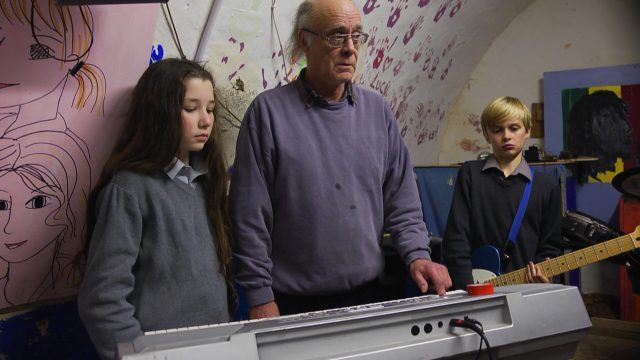
John Leyden teaches music to Headfort students in the extraordinary School Life

SCHOOL LIFE (Neasa Ní Chianáin & David Rane, 2017)
IFC Center
323 Sixth Ave. at West Third St.
Opens Friday, September 8
212-924-7771
www.schoollifefilm.com
www.ifccenter.com

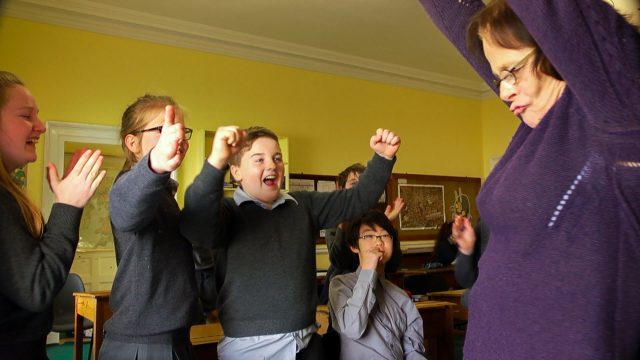
I never went to boarding school, but if I had, I’d like it to have been at the Headfort School in Kells, County Meath, Ireland, which promises “an education that lasts a lifetime.” The institution, founded in 1949 in a two-hundred-year-old building, is highlighted in the extraordinarily enchanting documentary School Life. Director and cinematographer Neasa Ní Chianáin and director and producer David Rane focus on the daily exploits of husband and wife teachers John and Amanda Leyden, who have been at Headfort for more than forty-five years. The film follows them from their quaint house to their classrooms and special projects: John, tall and thin, with an acerbic wit and scraggly white hair on the back of his head, is putting together the school rock band, while Amanda, short and stout with an infectious enthusiasm for life, is staging Hamlet with a handpicked group of students. Headmaster Dermot Dix, who attended the school himself and had the Leydens as teachers, gives them a wide berth, and they are allowed to be themselves, questioning the existence of a supreme being and supporting same-sex marriage; in fact, everyone at Headfort, from the teachers to the students and the administrators, is encouraged to be themselves, rather than pigeonholed into standard, uniform expectations. Dix even considers it a place where students can “horse around” and “get mucky and muddy”; at one point John, who also teaches math and Latin, is outside in the forest, pushing one of the girls on a makeshift swing. Previously titled In Loco Parentis — “in place of parents” — when it was a hit at Sundance, School Life rarely shows any mothers or fathers, which is extremely refreshing in this age of helicopter parenting. Ní Chianáin (Fairytale of Kathmandu, The Stranger) also avoids talking heads, instead opting for a fly-on-the-wall style that puts us right in the middle of things, without so-called experts explaining to us what is happening and why it’s all so engaging.

School Life

Amanda Leyden gets students excited about Shakespeare in Neasa Ní Chianáin and David Rane’s magical School Life

John and Amanda can be brutally honest when it comes to their students’ artistic talents — witness John’s interaction with a new girl who had stopped coming to the music room — but they care deeply about the kids, discussing them at home to figure out if they were too hard on someone or whether a specific child needs special attention. They both also know that this is what they were meant to do, and that they are still at the top of their game. “I wouldn’t be wasting their time if I was no good,” Amanda says. Meanwhile, John opines, “What else would you do all day?” As the end of the school year nears and the graduating students start receiving acceptances from their next institution of higher learning, there is a heart-tugging cathartic pain as they contemplate saying farewell to their Headfort friends, and particularly John and Amanda. You’re likely to feel the same way, having gotten to know such unique kids as Eliza, Florrie, Ted, Megan, Charlie, and Olivia while falling under the spell of the Leydens. “Remember me,” Ted shouts in the play, portraying the ghost of Hamlet’s father. After watching School Life, you’ll never forget the extraordinary John and Amanda Leyden and everyone else at Headfort. Is it too late to go back to boarding school?

MEMORIES OF MURDER

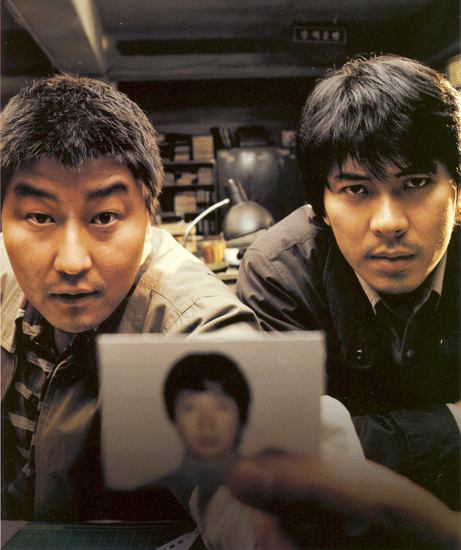
Local detectives are searching for a serial killer in Memories of Murder

Local detectives are searching for a serial killer in Memories of Murder

MEMORIES OF MURDER (SALINUI CHUEOK) (Bong Joon-ho, 2003)
IFC Center
323 Sixth Ave. at West Third St.
Opens Friday, August 18
212-924-7771
www.ifccenter.com

In 2006, South Korean writer-director Bong Joon-ho burst onto the international cinematic landscape with the sleeper hit The Host, a modern-day monster movie with a lot of heart. He followed that up with the touching segment “Shaking Tokyo” in the compilation film Tokyo!, and Mother, the futuristic thriller Snowpiercer, and Okja, about an extraordinary pig. IFC Center is now going back to Bong’s second film, 2003’s Memories of Murder, screening a new digital restoration beginning August 18. Inspired by actual events, Memories of Murder is a psychological thriller set in a rural South Korean town. With a serial killer on the loose, Seoul sends experienced inspector Suh (Kim Sang-kyung) to help with the case, which is being bungled by local detectives Park (Song Kang-ho) and Cho (Kim Roe-ha), who consistently tamper with evidence, bring in the wrong suspects, and torture them in both brutal and ridiculously funny ways. But as the frustration level builds and more victims are found, even Suh starts considering throwing away the book and doing whatever is necessary to catch the killer. Bong’s first major success, earning multiple awards at film festivals around the world, Memories of Murder is a well-paced police procedural that contains just enough surprises to overcome a few too many genre clichés. The film is beautifully shot by Kim Hyung-gu, from wide-open landscapes to a busy, crowded factory. But the film is dominated by Song’s (The Host, Thirst) big, round face, a physical and emotional wonder whether he’s goofing around with a prisoner or dead-set on catching a criminal.
WAVERLY MIDNIGHTS: STAFF PICKS — BORAT: CULTURAL LEARNINGS OF AMERICA FOR MAKE BENEFIT GLORIOUS NATION OF KAZAKHSTAN

Borat

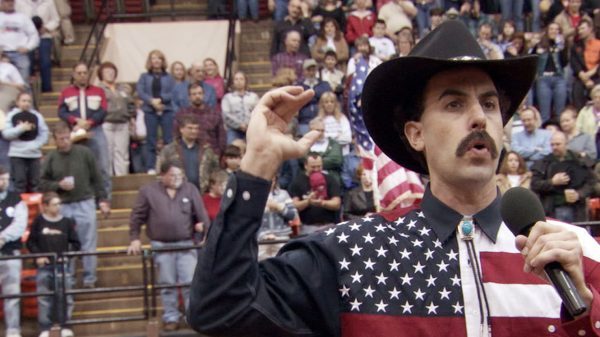
Sacha Baron Cohen takes aim at international relations in Borat

BORAT: CULTURAL LEARNINGS OF AMERICA FOR MAKE BENEFIT GLORIOUS NATION OF KAZAKHSTAN (Larry Charles, 2006)
IFC Center
323 Sixth Ave. at West Third St.
Friday, August 11, and Saturday, August 12, 12 midnight
212-924-7771
www.ifccenter.com
www.boratmovie.com

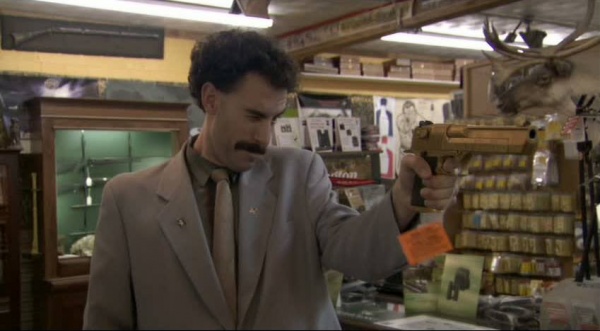
Believe the hype. Sacha Baron Cohen holds a mirror up to America, and you might not like what you see — although you’ll laugh your head off while watching it. Cohen stars as bushy haired Kazakhstan journalist Borat Sagdiyev, a role he created for Da Ali G Show, the 2001 series in which he interviewed such luminaries as Newt Gingrich, Boutros Boutros-Ghali, Andy Rooney, and Norman Mailer while pretending to be a British hip-hop wigger (Ali G); he also disguised himself as a German fashionista (Bruno) and Borat, a reporter who likes to talk about sex, especially with his sister. In Borat: Cultural Learnings of America for Make Benefit Glorious Nation of Kazakhstan, Borat leaves his little village in Kazakhstan and travels across the United States with his producer, the rotund Azamat (Ken Davitian), in search of his true love, Baywatch’s Pamela Anderson. Along the way, he is making a documentary about the American way of life, turning a revealing lens on racism, anti-Semitism, sexism, misogyny, homophobia, blind patriotism, fundamentalism, and southern hospitality, with a healthy dose of toilet humor (literally).

Borat

Sacha Baron Cohen takes on American values and more in Borat

The people he speaks with — a feminist group, gun and car dealers, rodeo cowboys, conservative politicians Bob Barr and Alan Keyes, etiquette and humor experts, Christian evangelicals at a revivalist tent meeting, drunk frat boys in an RV — believe he is really a Kazakh journalist, and Cohen holds nothing back, unafraid to ask any question or kiss any man, often risking his personal safety in hysterical ways. He’s got the biggest cojones we’ve ever seen — and you nearly get to see them when he and Azamat chase each other naked through a hotel, ending up fighting onstage at a mortgage bankers convention. Borat is more Easy Rider than Jackass and Beavis and Butt-Head Do America, a road trip movie that captures the state of the nation in frightening yet very funny ways. Curiously, the only Oscar nomination it received was for Best Screenplay, despite much of it being improvised. A film that probably couldn’t be made today, Borat is screening on August 11 and 12 at midnight in the IFC Center series “Waverly Midnights: Staff Picks,” selected by Andrew M. of the floor staff. The series continues with such other flicks as David Cronenberg’s Crash, James Cameron’s Aliens, and Jim Sharman’s Shock Treatment.

THE LAST DALAI LAMA?

Documentary celebrates the eightieth birthday of the Dalai Lama while looking at the future of the lineage

Documentary celebrates the eightieth birthday of the Dalai Lama while looking at the future of the lineage

THE LAST DALAI LAMA? (Mickey Lemle, 2016)
IFC Center
323 Sixth Ave. at West Third St.
Opens Friday, July 28
212-924-7771
www.ifccenter.com
www.thelastdalailamafilm.com

“So long space remains, so long sentient beings remain, so long suffering remains, I will remain. In order to serve. That is the real purpose of our life,” His Holiness the 14th Dalai Lama says at the beginning of Mickey Lemle’s documentary, The Last Dalai Lama. For nearly 450 years, the spiritual leader of Tibet has been known as the Dalai Lama, reincarnated to continue the lineage and guide the Tibetan people through his wisdom and compassion. But China, in its ongoing suppression of Tibet, has now decided it will choose the next Dalai Lama, so His Holiness, born Tenzin Gyatso in 1935, has vowed that if necessary, he will reincarnate as someone other than a Dalai Lama, bringing an end to the chain. Lemle introduced the world to the 14th Dalai Lama in 1993 with the release of Compassion in Exile: The Story of the 14th Dalai Lama; the new film, which Lemle wrote, produced, directed, and coedited, was made in conjunction with His Holiness’s eightieth birthday, which was celebrated with a Long Life Ceremony at the Javits Center in New York City (that we attended). The film reveals the Dalai Lama, a Buddhist meditation practitioner who escaped Tibet in 1959 and set up a new home in Dharamsala, India, to be both a mensch and a superstar, a man of deep, philosophical wisdom and great compassion for all sentient beings, as well as a very funny man with an infectious laugh. Lemle (The Other Side of the Moon, Ram Dass Fierce Grace) investigates the history of Tibetan relations with China while exploring the biography of the Dalai Lama, including interviews he made with him in the early 1990s.

Lemle speaks with Richen Khando Choegyal of the Tibetan Nuns Project about the self-immolation of young monks as a protest to Chinese policies, visits two classrooms in New York, and meets with HH’s younger brother, Tendzin Choegyal; HH’s personal physician, Tenzin Choedrak; chant master and longtime political prisoner Thupten Chokdhen; Dr. Daniel Goleman, author of A Force for Good: The Dalai Lama’s Vision for Our World; the Very Reverend James Parks Morton and the Very Reverend James A. Kowalski of the Cathedral Church of St. John the Divine, where Philip Glass, who composed the film’s score with Tenzin Choegyal, plays the pipe organ; Ling Rinpoche, the reincarnation of the Dalai Lama’s childhood teacher; Buddhist monk Dr. Mathieu Ricard, author of The Monk and the Philosopher: Buddhism Today; and HH’s translator, Dr. Thupten Jinpa. George W. Bush, who was the first U.S. president to make a public appearance with the Dalai Lama, awarding him the Congressional Gold Medal in 2007, shows off his portrait of HH. There’s also an intriguing section, with colorful animation, about the Dalai Lama’s interest in cutting-edge brain science, as he’s funding a project in which Dr. Eve Ekman and her father are creating an “atlas of emotions,” mapping enjoyment, ecstasy, fear, sadness, anguish, disgust, anxiety, and many others. Despite the problems with China, which are only getting worse, the Dalai Lama even has compassion for his enemies. He also discusses how this is not just about Buddhism. “We are working for seven billion human beings,” he tells Dr. Ekman. “That’s my view.” Meanwhile, the Very Reverend Kowalski asks, “Can human beings be this special?” According to His Holiness, every one of us has the potential to reach selfless levels of compassion, empathy, and peace of mind. The film can be scattershot and bumpy, jumping around too much, but the message is clear: Together we can change the world, but we must change ourselves first. The Last Dalai Lama? opens July 28 at IFC, with Lemle participating in Q&As following the 7:25 screenings on Friday and Saturday.