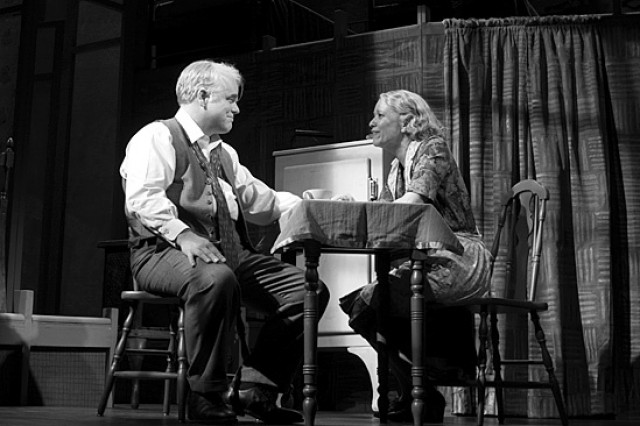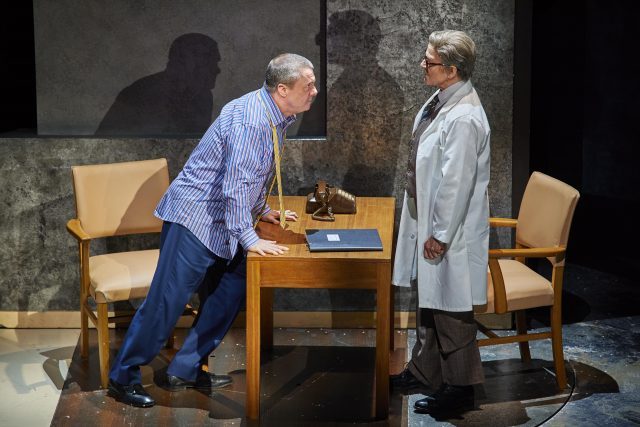
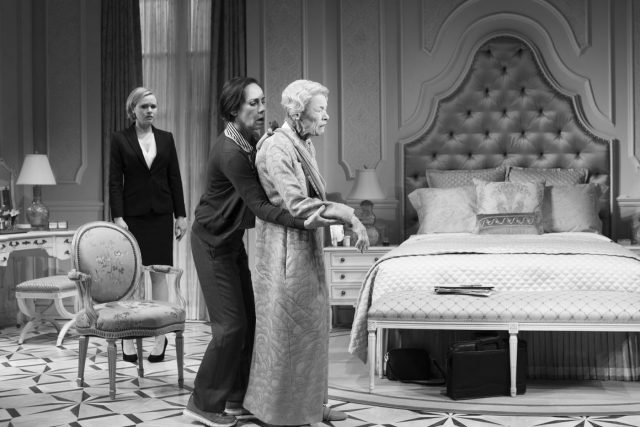
Roy M. Cohn (Nathan Lane) is not ready to accept his diagnosis from his longtime doctor (Susan Brown) in Millennium Approaches (photo by Brinkhoff & Mögenburg)
Neil Simon Theater
250 West 52nd St. between Broadway & Eighth Ave.
Wednesday – Sunday through July 15, $49-$169
angelsbroadway.com
I remember sitting in the Walter Kerr Theatre nearly twenty-five years ago, on back-to-back nights, watching Tony Kushner’s landmark two-part Angels in America: A Gay Fantasia on National Themes, a shattering, eye-opening experience that destroyed and reconstructed the limits of the very art form itself. The Ronald Reagan and George H. W. Bush administrations were over, but known deaths from AIDS in the United States were still rising — more than forty thousand in 1993 and more than thirty thousand in 1994 (to be followed by nearly fifty thousand in 1995 before a major corner in the treatment battle was turned). New York playwright Kushner brilliantly captured the wide-ranging horrors of the HIV/AIDS crisis from a sociopolitical, deeply personal angle in Millennium Approaches and Perestroika, nearly eight hours of intensely emotional theater, directed by George C. Wolfe. Angels is now back on Broadway, in a staggering, Olivier-winning Royal National Theatre production at the Neil Simon Theatre through July 15. Marianne Elliott, who won Tonys for her endlessly inventive direction of The Curious Incident of the Dog in the Night-Time and War Horse (the latter with codirector Tom Morris), has reimagined Angels for the modern age.
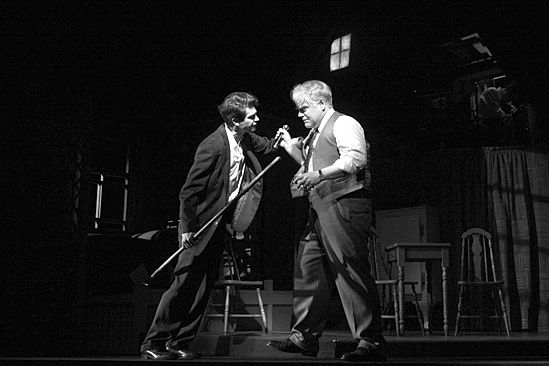
Millennium Approaches takes place in late 1985, with three interconnected stories moving between three changing, rotating sets cleverly designed by Ian MacNeil and beautifully lit by Paule Constable. Closeted attorney Roy M. Cohn (Nathan Lane), Sen. Joseph McCarthy’s chief counsel during the Army-McCarthy hearings, is a fast-paced, foul-mouthed wheeler dealer who, when told by his doctor (Susan Brown) that he has AIDS, insists, “No, Henry, no. AIDS is what homosexuals have. I have liver cancer.” Cohn is pulling strings to get law clerk Joe Pitt (Lee Pace) an important position in the Justice Department in Washington, but Joe doesn’t think the move will be good for his agoraphobic, Valium-addicted wife, Harper (Denise Gough). Meanwhile, when Prior Walter (Andrew Garfield) explains to his boyfriend, legal word processor Louis Ironson (James McArdle), that he has Kaposi’s sarcoma and is going to die, Louis can’t handle it and leaves him. The three plots intersect and weave together powerfully as Kushner and Elliott explore the characters’ unwillingness to face some difficult truths about themselves regarding sexual identity, honesty, and responsibility; the only one who accepts his fate is Prior, who begins hearing voices and then is visited by an angel (Amanda Lawrence, or Beth Malone on Wednesdays) who declares him to be a prophet.
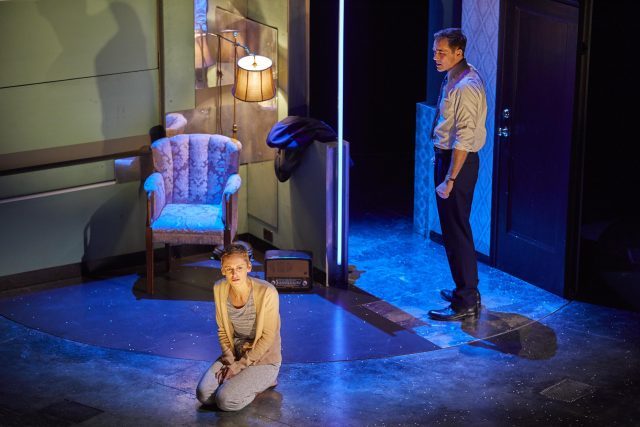
Harper (Denise Gough) and Joe Pitt (Lee Pace) face their demons in stunning revival of Tony Kushner epic (photo by Brinkhoff & Mögenburg)
At the beginning of Perestroika, the world’s oldest Bolshevik, Aleksii Antedilluvianovich Prelapsarianov (Brown), is standing at a podium in the Kremlin, announcing, “The Great Question before us is: Are we doomed? The Great Question before us is: Will the Past release us? The Great Question before us is: Can we Change? In Time? And we all desire that Change will come.” Those theories are addressed as Joe’s Mormon mother (Lawrence/Malone) comes to New York to save him from sin; Prior’s ex-boyfriend, a nurse named Belize (Nathan Steward-Jarrett), is assigned to take care of the hospitalized Cohn, who is being haunted by the ghost of Ethel Rosenberg (Lawrence/Malone); Joe and Louis grow closer; and Prior’s health continues to worsen even as he believes he might very well be a prophet, ordered by the Angel to “Submit to the will of Heaven!” Perestroika is staged very differently from Millennium Approaches; the revolving sets are gone, replaced by an often empty space in which individual elements are either wheeled in by mysterious Angel Shadows (Rowan Ian Seamus Magee, Matty Oaks, Jane Pfitsch, Ron Todorowski, Silvia Vrskova, and Lucy York), rise from beneath, or descend from above. “Perhaps it can be said that Millennium is a play about security and certainty being blown apart, while Perestroika is about danger and possibility following the explosion,” Kushner explained in a note on an earlier version of the script. (He has revised Perestroika over the years for previous revivals.) “The plays benefit from a pared-down style of presentation, with scenery kept to an evocative and informative minimum. . . . I recommend rapid scene shifts (no blackouts!), employing the cast as well as stagehands in shifting the scene. This must be an actor-driven event.”
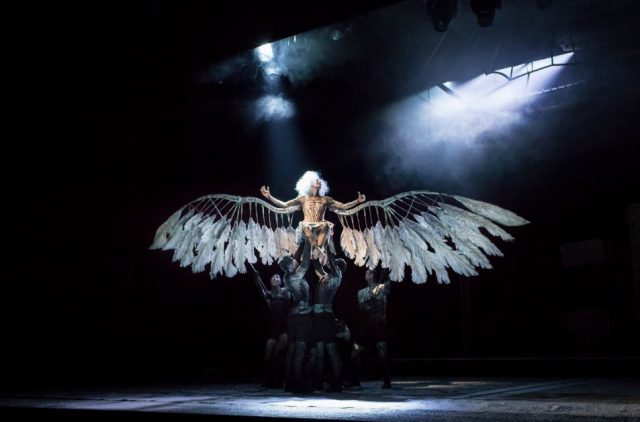
An angel (Amanda Lawrence) descends from Heaven to declare a new prophet in Angels in America (photo by Brinkhoff & Mögenburg)
Angels is indeed an actor-driven event, with sensational performances from the cast of eight, each playing multiple parts. Brown (Husbands & Sons, Playing with Fire), Lawrence/Malone (Here We Go, Tristan and Yseult / Fun Home, Ring of Fire), and Stewart-Jarrett (Wig Out, The History Boys) are particularly busy, taking on more than a dozen roles among them. Lane (The Iceman Cometh, It’s Only a Play) gobbles up Cohn, words flowing out in a fury. Gough (People, Places & Things, Desire under the Elms) brings an endearing tenderness to Harper, Pace (The Normal Heart, Small Tragedy) is strong and firm as Joe wrestles with his demons, and McArdle (Platonov, A Month in the Country) plays Louis with a sensitivity that belies his often-questionable actions. But Garfield (Death of a Salesman, The Amazing Spider-Man) soars above them all, fully embodying Prior, who is the show’s heart and soul. His physical and psychological ailing is palpable as he fights his disease while trying to find his place in a world that is getting away from him, his fears, though, somewhat offset by his unending hope. Elliott ably balances major dramatic scenes, such as when Prior gets into a fierce confrontation with the Angel, whose wings are operated by the Angel Shadows, with intimate moments like when Harper hallucinates, along with a large dose of comedy amid the heartbreak. Millennium might be three and a half hours and Perestroika four, each with two intermissions, but it doesn’t feel that long; they smoothly flow across time, and don’t be surprised if you make friends with those around you, especially if you’re seeing both shows the same day in the same seats. Kushner (Homebody/Kabul, Caroline, or Change) wrote, “I believe that, once engaged, audiences rediscover the rewards of patience and effort and the pleasures of an epic journey. An epic play should be a little fatiguing; a rich, heady, hard-earned fatigue is among a long journey’s pleasures and rewards.” Twenty-five years after their Broadway debut, on a planet where one million people die annually from AIDS and tens of thousands of Americans still contract HIV every year, this epic journey is more than worthy of rediscovery, in a stunning revival that hits just as hard today as it did a quarter century ago.
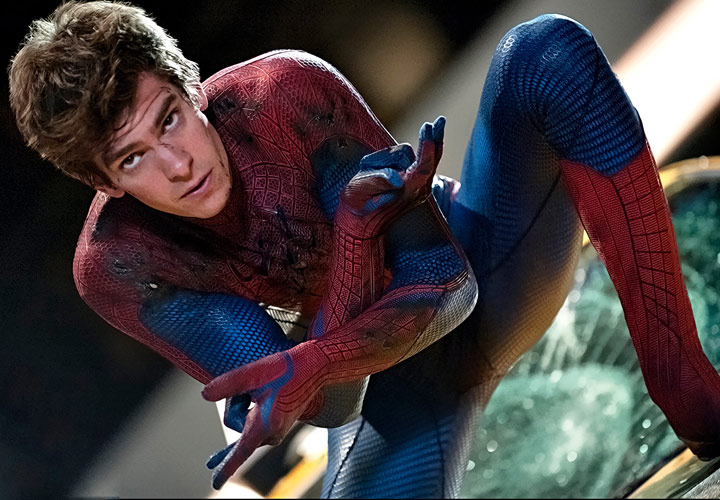
 Originally announced to be the fourth Spider-Man movie in the franchise restarted in 2002 by Sam Raimi that featured Tobey Maguire as Peter Parker and Kirsten Dunst as Mary Jane Watson, The Amazing Spider-Man instead goes back to the beginning, telling a different origin story that mixes elements of various issues of the immensely popular comic book hero. The first third of the new film works extremely well, as Peter (Tony-nominated British actor Andrew Garfield) falls for beautiful blonde Gwen Stacy (Emma Stone), is bitten by a radioactive spider developed by the one-armed Dr. Curt Connors (Rhys Ifans), and learns how to use his new strength to battle high school bully Flash Thompson (Chris Zylka) while having difficulty explaining himself to Uncle Ben (Martin Sheen) and Aunt May (Sally Field), who raised him after his parents’ disappearance. It’s even directed by a man named Webb, as if it was all meant to be. But soon Marc Webb, a longtime video director whose breakthrough was 2009’s (500) Days of Summer, lets things get way out of hand as the film devolves faster than you can say “With great power comes great responsibility” (which nobody actually says in this film), with gaping plot holes so big you can drive a New York City crane through them — and when the cranes do in fact show up, they elicit well-deserved groans from the audience. The Amazing Spider-Man works best when Garfield and Stone are on-screen together, their blossoming romance building slowly but elegantly, perhaps representative of real life, as they became one of Hollywood’s hottest couples while making the film. But as Connors transforms into the Lizard, The Amazing Spider-Man loses its focus, turning into yet another CGI-crazed monster movie with silly plot twists, annoying red herrings, and ridiculous segments. (Just what’s up with that antidote, and why do villains always build self-destruct machines that have to count down really loudly?) Even the 3D that worked so well in the beginning seems to have been forgotten in the second half. This reboot deserves a swift boot in the you-know-what, especially given the promise of its opening scenes. The Amazing Spider-Man, is screening August 14 as part of the South Street Seaport’s “Front/Row” “See/Change” series, which continues August 17 with Chicago and August 21 with Back to the Future. For a day-by-day listing of free summer movie screenings throughout New York City, go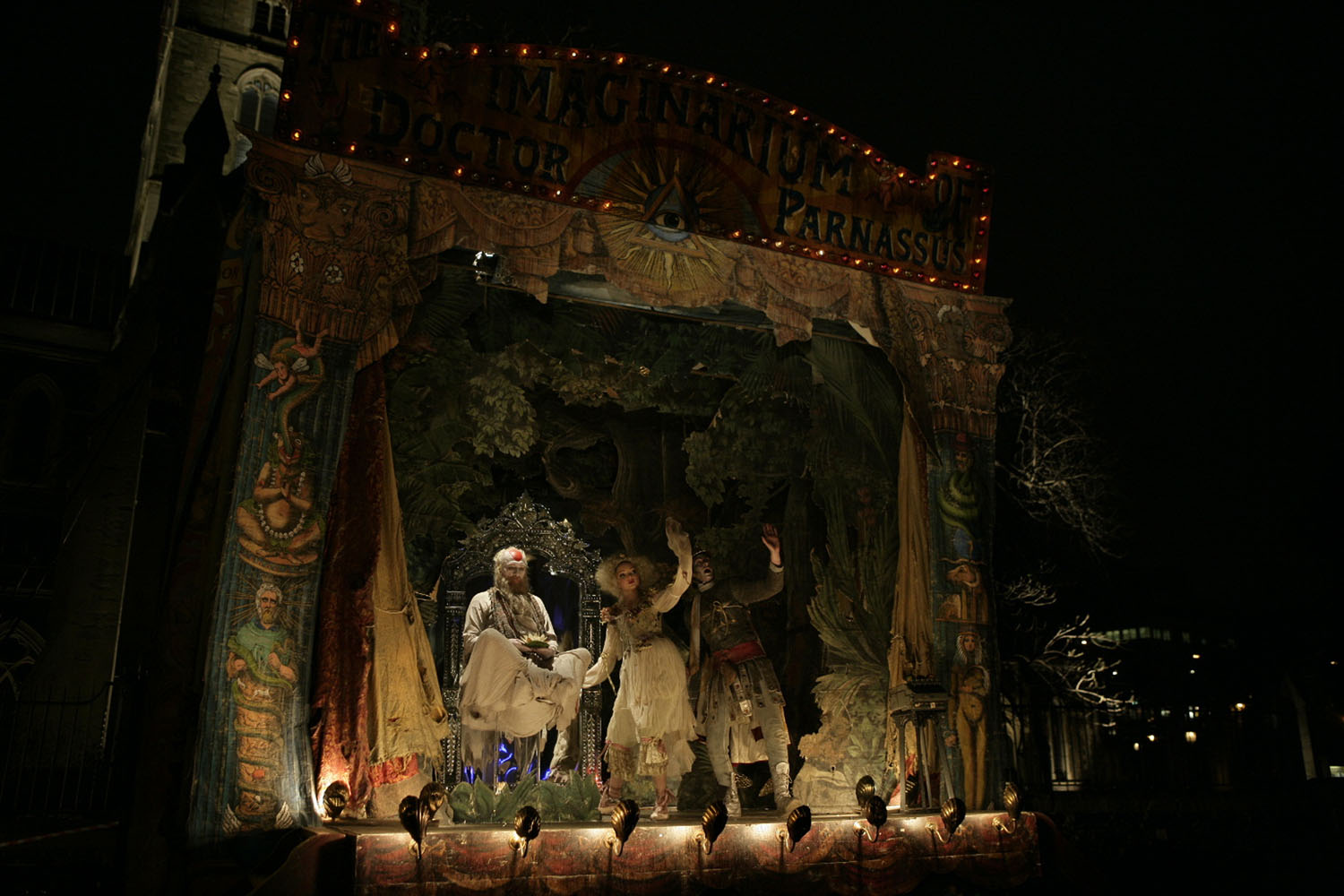
 Longtime Monty Python animator Terry Gilliam is perhaps the most frustrating filmmaker of the last thirty years. A remarkable talent whose works are often mired in controversy, from going way overbudget to having to deal with severe illness and even death on his sets, Gilliam has made such pure gems as Time Bandits (1981), Brazil (1985), and The Fisher King (1991) as well as such disasters as Fear and Loathing in Las Vegas (1998), The Brothers Grimm (2005), and Tideland (2005). His last real success was Twelve Monkeys (1995), making it nearly fifteen years since he’s made a worthwhile movie. His 2009 adult fairy tale, The Imaginarium of Doctor Parnassus, is reminiscent of his 1988 film, The Adventures of Baron Munchausen, a somewhat underrated though hit-or-miss effort that reached lofty heights while flirting with utter ridiculousness. Cowritten by Gilliam and Charles McKeown (who also collaborated on Brazil and Munchausen), Parnassus is built around a Faustian plot in which a monk, Dr. Parnassus (Christopher Plummer), who thinks his sect controls the story of the world, makes a deal with Mr. Nick, the devil (Tom Waits), involving Parnassus’s daughter, Valentina (Lily Cole). Valentina is part of the doctor’s traveling sideshow, along with the trusted, all-knowing Percy (Verne Troyer) and assistant Anton (Andrew Garfield), who is in love with Valentina but is unable to express his desire. The ramshackle show offers people the chance to walk through a mirror into their own private fantasy — during which they will eventually face a decision regarding their own potential deal with the devil. When the oddball troupe discovers a man hanging by his neck under a bridge, they welcome the charming, handsome, deeply mysterious stranger (Heath Ledger) into their outfit, but he is hiding a secret that could tear everything apart. Parnassus is an up-and-down affair in which a captivating, beautiful scene will be followed by a baffling segment that borders on the incompetent, as if the filmmakers forgot to edit it properly or couldn’t afford more takes to improve it. Fortunately, the last half hour is thrilling, especially how Gilliam and McKeown rework the script to deal with Ledger’s death when several key scenes still needed to be shot. The Imaginarium of Doctor Parnassus is screening in a DCP projection at midnight on May 17 & 18 as part of the IFC Center Waverly Midnights series “Terry Gilliam,” which continues through July 20 with such other fine Gilliam fare as Time Bandits, Jabberwocky, and Brazil.